


Cloud Orchestration Service for SAP Environments
The cloud needs a conductor
Migrating systems to a private or public cloud changes the way SAP systems are used, but it does not eliminate the company’s responsibility for their continuity, security, and performance. In hybrid models and SAP Cloud, responsibility is shared among the customer, SAP, the maintenance partner, and other providers. The more entities involved in service delivery, the more important it is to manage them in a coordinated manner. The Cloud Orchestration Service from All for One’s Smart Services portfolio bridges the gap between the standard scope of cloud services and business needs.
Migrating systems to a private or public cloud changes the way SAP systems are used, but it does not eliminate the company’s responsibility for their continuity, security, and performance. In hybrid models and SAP Cloud, responsibility is shared among the customer, SAP, the maintenance partner, and other providers. The more entities involved in service delivery, the more important it is to manage them in a coordinated manner. The Cloud Orchestration Service from All for One’s Smart Services portfolio bridges the gap between the standard scope of cloud services and business needs.
Migrating SAP systems to the cloud is often presented as a way to reduce IT complexity. When it comes to infrastructure, this is largely true: a company does not have to maintain its own data center, purchase servers, or manage all the technical components of the platform. However, this does not mean that the responsibility for the smooth operation of the entire environment disappears. Above all, the distribution of that responsibility changes.
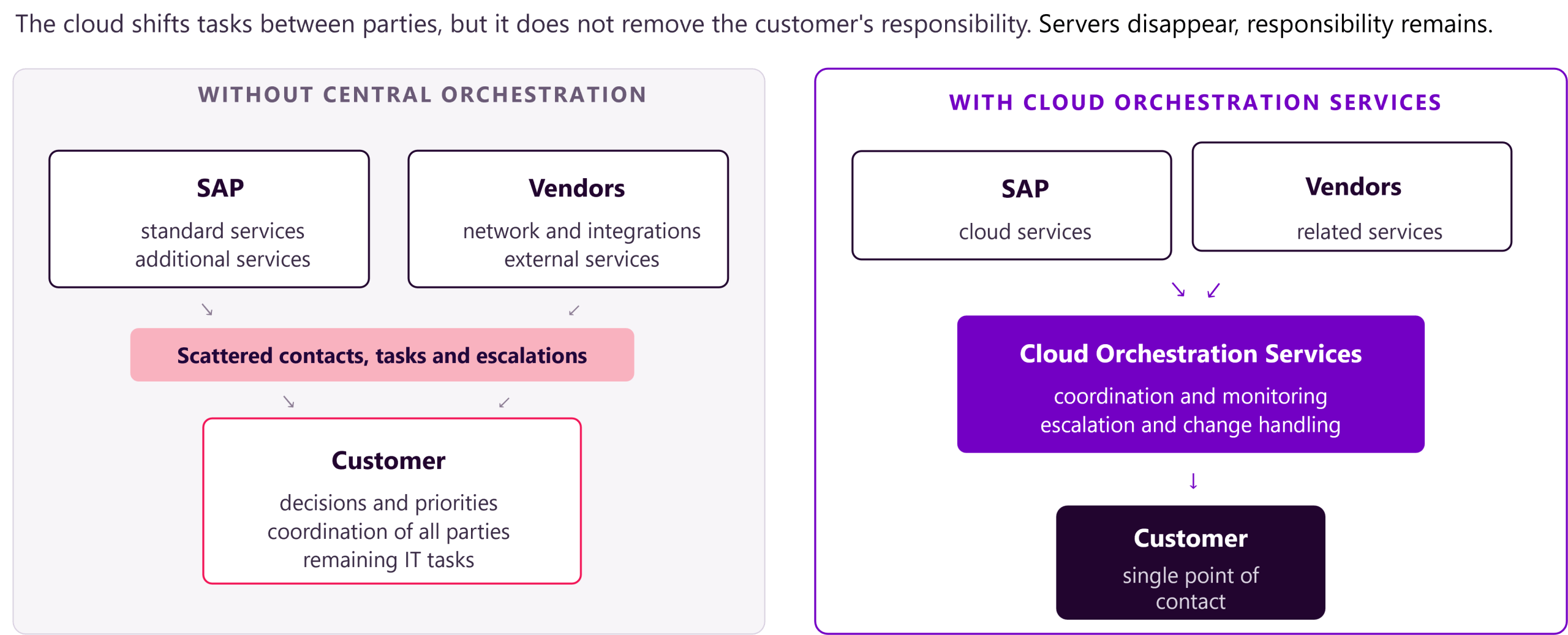
SAP performs some tasks as part of its standard service; others may require the purchase of additional services; and still others remain the responsibility of the customer. Added to this are systems and services from other vendors, integrations, the network, authentication mechanisms, and solutions hosted in the company’s own data center.
As a result, the environment may be technically maintained by several specialized partners, but from a business perspective, it must still function as a single, cohesive system.
A Change in the Accountability Model
Servers Disappear, but the Responsibility Remains
In the traditional operating model, the customer or its maintenance partner controlled most elements of the SAP environment. In the cloud, there is no longer such freedom of access to the infrastructure, and performing many operations requires contacting the provider and following its procedures. New dependencies, communication channels, and escalation paths emerge.
The biggest challenge, therefore, is not limited to the technical maintenance of individual services. It lies in coordinating incidents, changes, updates, security, performance, interfaces, and dependencies between systems.
A good example is an integration issue. An interface may be unavailable due to an application error, SAP configuration, a certificate, a network service, or a third-party solution. Each vendor may be fulfilling their contractual obligations correctly, yet the entire business process will still remain unavailable. To quickly restore functionality, you need to identify the source of the problem, involve the appropriate specialists, coordinate their work, and ensure the incident is resolved.
A similar situation occurs when copying a system or client, deploying a new version, installing patches, or renewing certificates. SAP can perform the operation within its scope, but preparing the environment, ensuring integration, checking dependencies, and restoring business processes may still require work on the customer’s part.
A single coordination center for the entire community
We need a competent broker
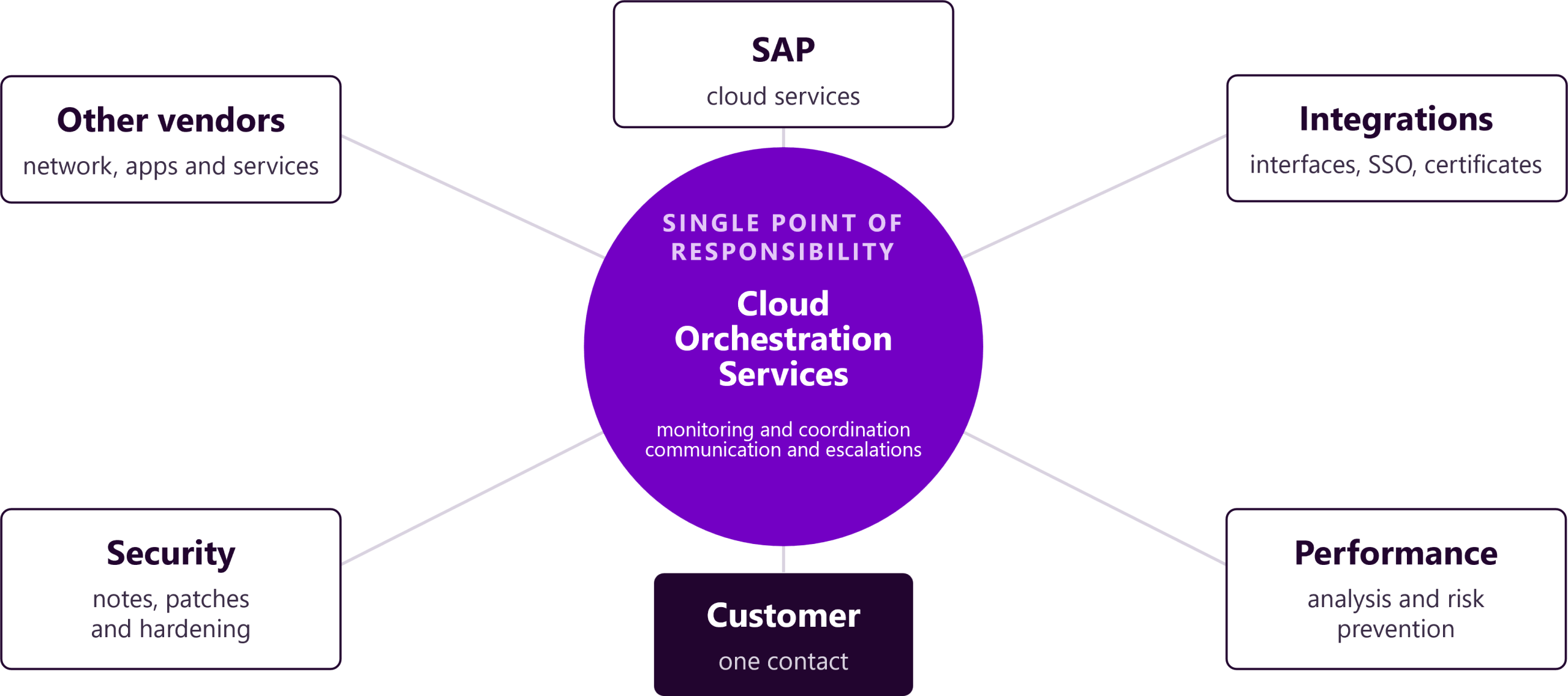
An organization using cloud services needs a partner who understands SAP technology, how cloud services work, and the importance of these systems to business processes. This is not about adding another layer of administrative intermediation. What is needed is the expertise to translate business needs into technical tasks, verify the division of responsibilities, and effectively manage the project across multiple providers.
This role is fulfilled by the Cloud Orchestration Service from the Smart Services portfolio, provided by All for One. The service ensures centralized management of the SAP cloud environment, rather than leaving the customer to manage distributed components and contracts on their own. All for One takes over the coordination of communication with SAP and—depending on the agreed-upon scope—with other involved parties.
The customer retains control over priorities and business decisions, but does not have to determine on their own which provider to direct the request to, what kind of diagnostic data to prepare, or when to initiate an escalation. They have a single point of coordination that understands their environment and remains responsible for guiding the case through the entire service process.
This is particularly important in the case of incidents involving more than one service. Instead of forwarding the ticket between providers and monitoring each one’s work separately, the customer can focus on the business impact and priorities. The Cloud Orchestration Service handles the technical coordination and communication needed to find a solution.
From Response to Prevention
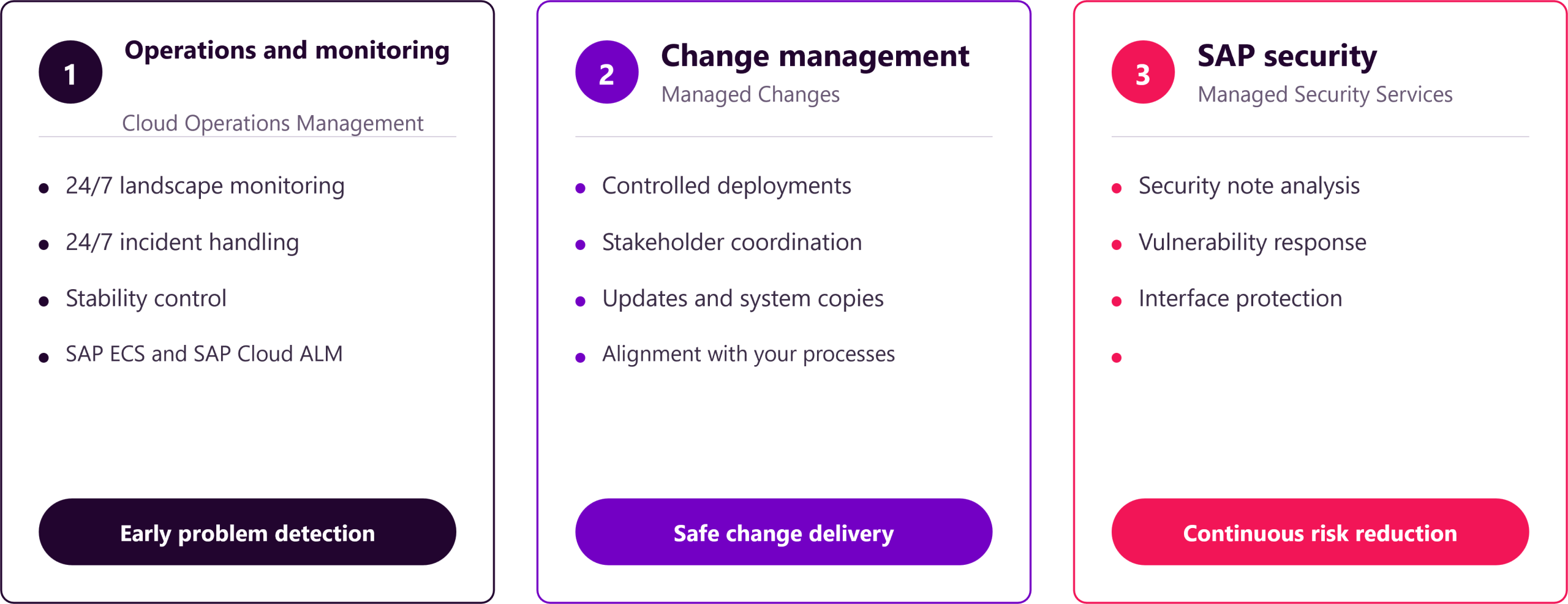
The service is based on proactive, round-the-clock monitoring of the environment, utilizing, among other tools, SAP Cloud ALM. Its goal is to ensure transparency regarding the status of services and to detect anomalies as early as possible. Monitoring is integrated with 24/7 incident management, ensuring that the detection of a problem can immediately trigger the appropriate actions.
However, simply collecting alerts does not ensure business continuity. An alert must be interpreted in the context of the customer’s specific environment and processes. Next, its significance must be determined, the responsible party identified, the necessary information provided to them, and the implementation monitored. Only this combination of monitoring tools and operational expertise allows us to move from simply observing the system to actually managing the service.
The Cloud Orchestration Service includes regular operational support and reporting. Regular service meetings and monthly reports provide the customer with insight into the state of the environment, key events, changes implemented, and areas requiring decision-making. They also enable the analysis of recurring issues and the planning of preventive measures.
The Three Pillars of Cloud Orchestration Services
Changes Under Control
The SAP environment is not a static solution. Application versions, databases, technical components, and security requirements are constantly changing. New interfaces are created, users gain new ways to access the system, and business processes are expanded. Each of these changes can affect components maintained by different vendors.
As part of Managed Changes, All for One can take over the coordination of changes and their associated dependencies. This includes, among other things:
- updates to releases and versions,
- change management,
- copying SAP systems and clients,
- certificate management,
- Single Sign-On configuration,
- maintenance of interfaces,
- print settings,
- performance analysis and optimization.
The scope of necessary tasks usually goes beyond simply commissioning SAP to perform the work. Before making the change, you need to check the technical requirements, integrations, and potential impact on the business. After the change is implemented, you must verify the environment, restore or review selected configurations, and confirm that key processes are functioning properly.
The Cloud Orchestration Service covers the preparatory work and execution of “POST steps,” which are not always included in a cloud provider’s standard scope of services. As a result, responsibility for the success of the change is not spread across multiple organizations.
Security is a process
Migrating a system to the cloud does not relieve a company of its responsibility for risk management. The provider secures the components within its scope, but the customer must still assess the significance of vulnerabilities to its own environment, make decisions regarding the timing of patch implementation, and monitor integration points.
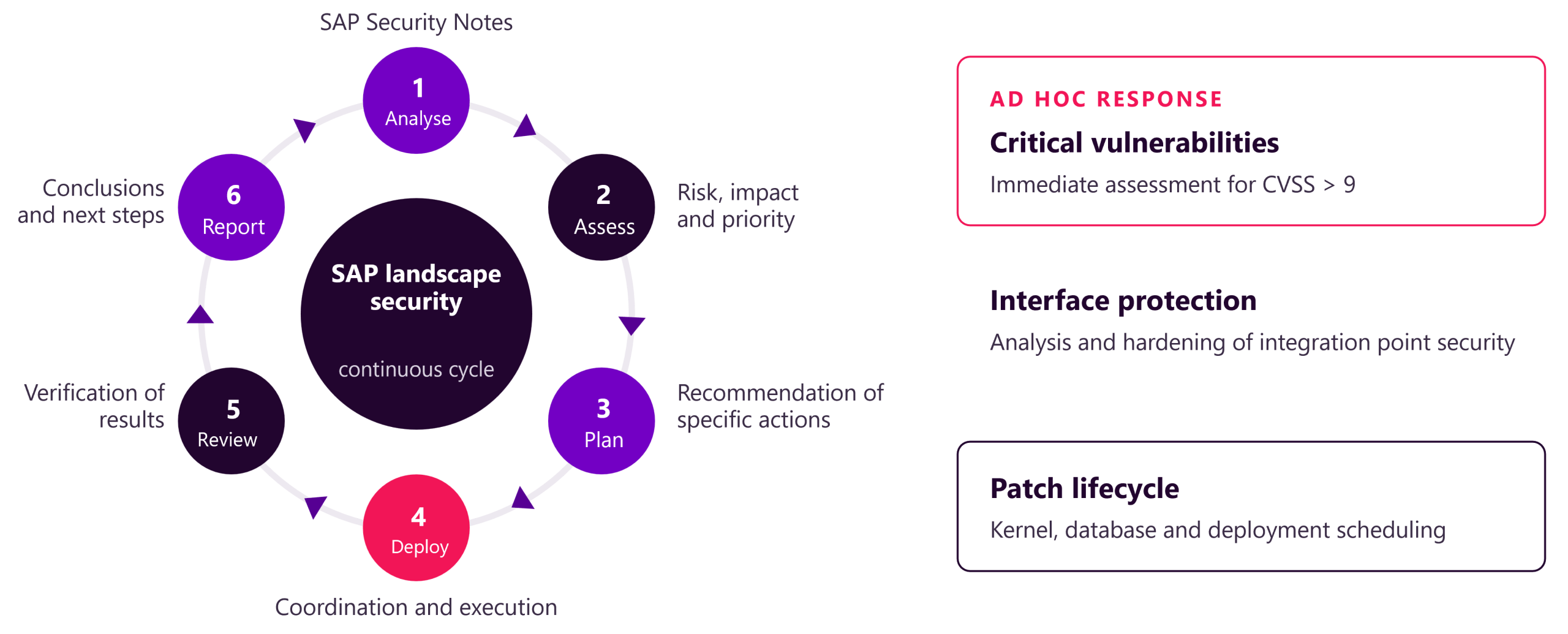
In the Cloud Orchestration Service, security is treated as an ongoing process. The service may include a monthly review of SAP security bulletins, their analysis and assessment, and the preparation of specific recommendations. In the case of critical vulnerabilities with a CVSS score above 9, ad hoc measures are in place to quickly assess the risk and initiate an appropriate response.
Another important element is patch lifecycle management. This includes recommendations for operating system and database patches, as well as coordinating their implementation—in consultation with and with the approval of the business—within mutually agreed-upon deadlines.
Interfaces require a separate approach. Integrations connect the SAP environment with internal applications, public clouds, Microsoft Azure services, and business partner systems. Analyzing and strengthening the security of integration points helps mitigate risks arising from outdated configurations, inadequate communication protection, or expiring certificates.
SAP Security as an Ongoing Process
Efficiency requires looking at the big picture
A cloud provider’s responsibility for infrastructure availability does not automatically imply responsibility for the performance of every business process. Slow transaction processing may stem from the application code, configuration, database, integration, network, or the way the system is used.
Therefore, a key component of the service is performance analysis based on best practices, monitoring, and alerts. Its purpose is not only to find the cause of an existing problem but also to identify symptoms that could lead to overload or service interruption. A quarterly performance analysis can serve as an optional extension to regular service.
Before launching the service, it is possible to conduct a technical assessment of the environment. This assessment helps identify the existing architecture, define the scope of responsibility, map out dependencies, and pinpoint areas requiring optimization. Based on this, the service model can be tailored to the company’s actual needs.
A Single Model for a Hybrid Environment
The Cloud Orchestration Service is modular and hybrid in nature. It integrates day-to-day IT operations, change management, security, performance, and environment development. It can support both SAP Cloud services and components that remain within the customer’s infrastructure or are maintained by other providers.
This approach reflects the reality for most organizations. Migrating to the cloud rarely means moving all systems to a single provider at once. For many years, companies have been using SAP services, public clouds, on-premises applications, and third-party solutions in parallel. The more decentralized the technical infrastructure becomes, the stronger the central control required to manage it.
The benefit of implementing the Cloud Orchestration Service is therefore not limited to reducing the IT team’s workload. The most important change is the creation of a transparent operational model: it is clear who is responsible for receiving a problem, who coordinates communication, how escalations are handled, and how changes and risks are managed.
The Cloud from a Business Perspective
From the users’ perspective, it doesn’t matter whether the unavailability of a process stems from the infrastructure, the application, the network, or integration. The system simply has to work. Therefore, cloud service management cannot be limited to monitoring the parameters of individual components. It must take into account the entire chain of dependencies leading to the execution of the business process.
The Cloud Orchestration Service bridges the gap between the customer’s organization, SAP, and other vendors. It provides the expertise needed to understand lines of responsibility, diagnose problems, and coordinate actions. It transforms a fragmented service landscape into an environment managed according to consistent principles.
Moving to the cloud does not, therefore, mean that maintenance skills become obsolete. On the contrary—their nature is changing. Instead of focusing on managing a single server, one must manage a service that spans multiple providers, multiple technologies, and shared responsibility for business outcomes.
That’s exactly what the Cloud Orchestration Service is designed to do: give customers control over their environment without having to manage every aspect of it themselves. This allows internal teams to devote more time to developing processes and leveraging technology to build a competitive advantage, while All for One ensures the smooth, secure, and coordinated operation of the SAP infrastructure.