


Since 2002, WSK PZL Rzeszów has been part of United Technologies – a global, worldwide corporation. With the changes in ownership, a process of change began, focusing primarily on raising the company’s organizational, technological and technical level. WSK PZL Rzeszów is now using the latest technologies to save time and reduce production costs. It is improving in many areas of its business by implementing more SAP solutions. One of them is SAP DMS, which supports the management of technological documentation.
The scale of the problem
The production of WSK Rzeszow is carried out strictly according to detailed technological documentation, describing the activities performed by operators, dimensional data, technical conditions, inspection plans, tooling lists. Due to the large amount of documentation and the number of changes, it became increasingly important to streamline the process of management and documentation creation.
“Before 2011, management of technological documentation was based on procedures and instructions. The primary information carrier was paper documentation supervised by a group of authorized employees," says Mariusz Rytel, Project Manager from WSK Rzeszow.
This state of affairs caused certain problems in records management, the most important of which are:
- Documentation updated in various places and in various forms (paper, local disks, SAP, etc.),
- Documentation stored in paper form in departmental archives requiring manual changes and manual recording,
- Increased time to develop documentation due to scattered data and its different forms.
In 2009, a decision was made to implement an electronic technology documentation management system. Initially, the intention was to use the EMC Documentum system for this purpose and integrate it with SAP. This idea was abandoned due to objective reasons beyond WSK’s control, such as corporate policies and legal requirements.

Mariusz Rytel, Project Manager, WSK PZL Rzeszow
They started looking for another way to improve the process of managing technological documentation. It decided on a project that involved extending the SAP PP module and using the SAP DMS (Document Management System) solution. In addition, WSK decided to extend SAP DMS with dedicated programs to support the processes of creating technical documentation. These programs were planned to be created in SAP ABAP, JAVA, NET technologies. The entire project – the implementation of this complex solution supporting the management of technological documentation in SAP – was entrusted to BCC (currently All for One Poland) as an implementation partner. At the end of 2010. WSK began using the new functions.
Technology documentation management system based on SAP DMS
Currently, in the Rzeszow plant, technological documentation is managed from the SAP DMS level in integration with the SAP PP module, which means that the functionality is implemented directly in the SAP system, without the need to maintain additional interfaces or “third-party" applications. This translates into simplicity of IT infrastructure administration and, indirectly, a reduction in IT costs.
SAP Content Server was used as the document repository for the new solution. It is a stand-alone SAP component for storing a large number of electronic documents of any form, which integrates with SAP ArchiveLink, SAP DMS, SAP Business Workplace or SAP KW (Knowledge Warehouse) technologies. Due to the large volume of documentation, the scalability of this solution was a very important advantage. As part of the described project, Content Server was installed on a Linux server and uses the MaxDB database (although it is also available for Windows systems).
What is SAP DMS?
SAP DMS easily allows authorized users to manage electronic documents. There are 4 basic transactions cv01n, cv02n, cv03n, cv04n (create, change, view, search documents). The DMS document itself is a container that allows you to attach files, versioning or partitioning. You can also model the tree structure of documents and define the status path, which will affect the process of archiving files on Content Server. At the configuration stage, you can specify which DMS elements will be active, as well as what types of physical files will be “stored" in a given document. Access to documents, as well as to the files in them, can be restricted using standard SAP mechanisms.
The basic functionality of DMS documents has been used in Rzeszow, namely, they are used to manage changes in technology marshaling by automatically versioning DMS documents and managing their statuses. The key element of this mechanism is the basic SAP functionality of change management with approval key (cco1, cc02, cc03). In addition, DMS documents are used to store technical drawings saved in PDF format.
As part of the project, an extension was also added to the standard DMS functionality, with the help of which there is an automatic attachment of files with drawings when the status of a DMS document changes. In order to facilitate the management of a large number of documents, an additional report has been created that allows for a mass change of document statuses.
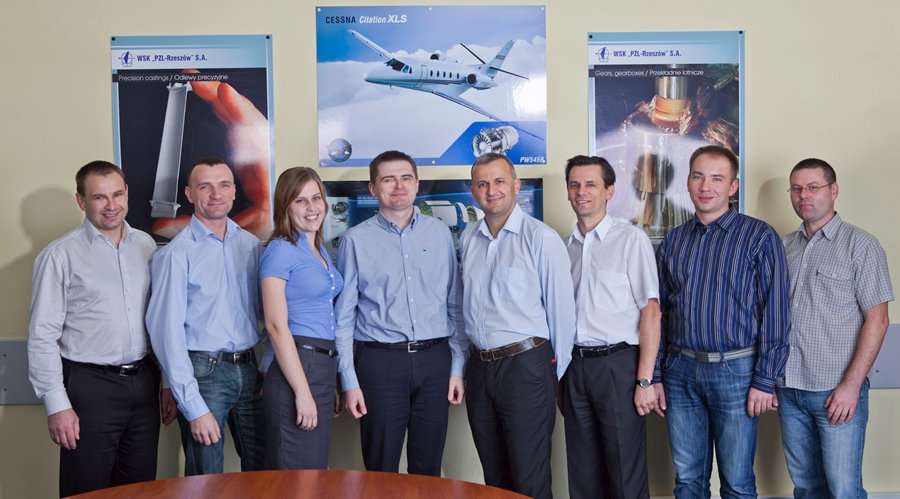
Many people from WSK PZL Rzeszow and BCC were involved in the project. Pictured is the main project team from WSK PZL Rzeszow. From left: Stanisław Zagaja, Paweł Reszko, Monika Oliwa, Mariusz Rytel, Dariusz Wojtasik, Piotr Cieślak, Waldemar Pitera, Tomasz Skała
PP module vs DMS
The integration of the DMS module with production planning in SAP involves the use of the standard functionality of connecting DMS documents to operations that are part of the technological route. It assumes the ability to manually connect a document to an operation as a production auxiliary. To streamline the entire process of creating and changing operations, an extension was made that automatically generates new versions of DMS documents and connects them to the corresponding operations. The program that carries out these processes is the most important and also the most complicated part of the new solution from the SAP side.
The design assumptions at WSK Rzeszow included several cases:
- creation of new technology;
- creation of a new technology from a template (already existing technology);
- Change of technology – addition, deletion, change of operations; addition, deletion, change of production aids (MPCs), change of characteristics, change of long texts on operations;
- Changing technology using transactions for mass change.
The first two cases were relatively simple to implement. The first boiled down to creating new DMS documents in zero versions and connecting them to the operation, while in the second case, an action was performed before document generation to delete old documents that had been copied from the master technology. In the case of changing the technology, a special mechanism was added to verify what elements were changed. Administrative users are able to select fields from operations, production aids and characteristics, the change of which will activate the mechanism for generating a new version of the document. Thanks to this solution, not every change on the technology is treated as a key change, triggering the processing of DMS documents.
In addition, a number of smaller improvements affecting the consistency and correctness of the entire process have been implemented in the PP module. A report has been prepared that allows you to quickly verify the correctness of connecting documents to operations on a given technology.
The application that creates the final technological instruction
The second component of the new solution is the part responsible for creating technical documentation. According to earlier assumptions, the program was to convert PDF files uploaded to the Documentum system into a single format on the workstation. As part of the described project, a server application was created, which, using data collected in SAP, PDF templates and DWG files (created, for example, from AutoCAD applications), can generate technological documentation (the entire technology, individual operations) in PDF format. Such a solution allows the generation of technology plans for a specific date – the result is the plan that was in effect on that day.
The starting point of the entire process is a transaction in SAP, with which we designate the technology (operation) we want to display. SAP then generates XML files containing all the data we need contained in the technology, saves it to a network location and launches a website. The website is written in JAVA technology, and its task is to process the data from the XML file and display a PDF document with the technology plan.
The generation of the document is interesting in that the creation process uses PDF templates that allow you to arrange the data taken from SAP in any way you want. This modification does not require changes in the program code, only in the templates. In addition, in the configuration file we have the possibility to set some elements of the printout – font, width of frames. In the process of creating technology, the designer has the option to load a graphic design from a DWG file. An additional application (.NET) is then launched, which converts the sketch to PDF files, then the files are attached to our templates and displayed on the monitor screen.
Data security
Due to the nature of the stored information (valuable company know-how, patents), it was important to develop an appropriate system of authorizations to exclude unauthorized access to individual resources. “Permission management was based on standard SAP mechanisms and appropriate roles. With the help of roles, individual authorizations for status changes on DMS documents are also controlled, and consequently the identification of relevant approvals of the company’s technological documentation. Due to the fact that WSK’s systems are largely integrated with those of the corporation, the decision was made not to include technical data on military products manufactured by the company in SAP," – Mariusz Rytel says.

Tomasz Wiernicki, IT Director, WSK PZL Rzeszow
Project Summary
When asked about the benefits of the project, Tomasz Wiernicki, IT Director at WSK PZL Rzeszow, answers: “the implementation of the solution has made it possible to create a single, integrated source of technology documentation, which provides version management of documentation, improves control over access levels and speeds up access to up-to-date technology information. The tangible benefits are:
- Reduction of waiting time for information (technological documentation always available),
- A reduction in “non-value added" activities, which resulted in a reduction in the average time to develop a new technology,
- Standardization of the work of technologists has had an impact on reducing the risk of the effects of documentation errors.
The implementation paves the way for further projects to optimize the company’s processes, such as distributing and displaying documentation electronically at operator stations on the production floor."