

Complex distribution network
High-quality raw materials, modern production facilities and excellent products are not enough. For success in the competitive meat market, a third element is still needed – efficient distribution and constant availability of goods.
Expanding and upgrading the distribution network in the Sokolow Group is one of the priorities of the company’s development program and strengthening its market position. The company’s products are available in all provinces, through various distribution channels. A significant customer (giving more than 30% of revenues) are large chains of super- and hypermarkets, serviced directly by production plants and their affiliated logistics warehouses. More than 27% of revenues come from export sales. Private wholesalers are also an important customer.
The distribution channel, generating nearly 24% of revenues, is a modernly organized network of own meat and sausage wholesalers and distribution centers, spread throughout the country. Each of the 42 wholesalers is responsible for timely deliveries, covering Sokolow’s full range of products, from all seven production plants.
The customers of the distribution centers are mainly individual stores or small local retail chains with a few dozen stores each.
Such a distribution model – while modern and, more importantly, efficient – poses quite an organizational challenge, requiring simultaneous coping with handling two different sales channels.
Sales conducted directly by factories are more orderly, because they usually take place on the basis of long-term contracts or at least agreed-upon terms of cooperation. One-time transactions are significantly larger and fewer in number.
Company wholesalers also sign contracts with their customers, but operate mainly on the basis of ongoing orders placed by many customers. There is also a significant group of one-time customers who are not bound by any permanent contracts with Sokolow. Orders are usually received in the very early morning hours and fulfilled the same day. Their number is very large – collectively, the wholesalers handle more than a million sales transactions a year – but the batches ordered are relatively small.
Registration of sales in wholesalers
The Sokol Group previously used a dedicated solution to record sales of its own wholesalers. Since the Group’s implementation of the central SAP system, the application was connected to SAP via an interface. A significant disadvantage of such a solution was the very long delay in providing sales data to SAP. It was also disadvantageous that in the previous system reporting always took a very long time, and in the central system data from the wholesalers was not available at all.
The interface transfer of inventory information to SAP ERP also worked unsatisfactorily. In the old system and in SAP, inventories were never the same, making it impossible to reliably assess the value of inventory. In addition to the lack of access to up-to-date information, a big issue was the system’s inability to manage the wholesaler’s operation in real time, such as through central pricing. Price lists were prepared in Excel files and sent by fax or email. At the wholesaler, someone had to enter these prices manually into the sales application, which involved delays in entering them and the possibility of mistakes.
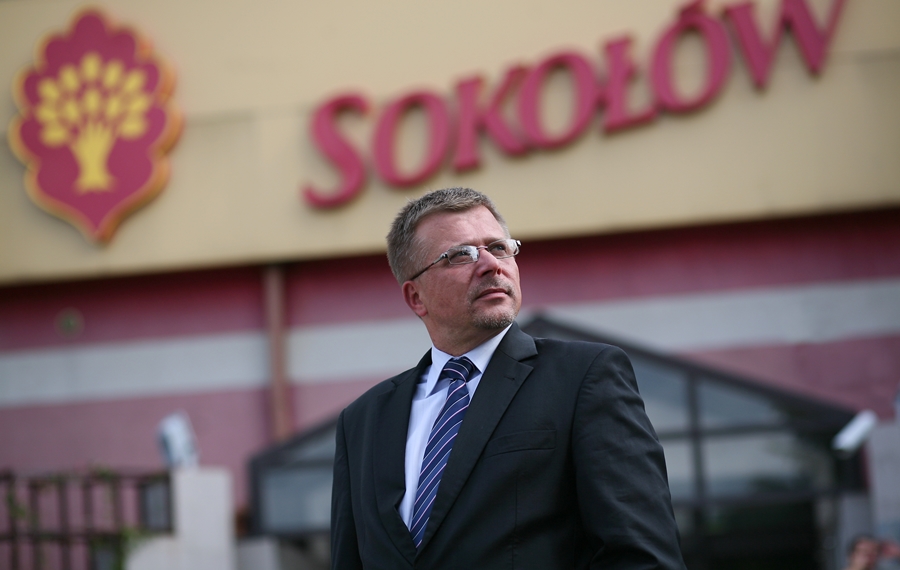
Andrzej Gorec, Deputy Director of Traditional Sales for Own Chain Trading, Sokołów Group
Challenges mobilize us
As is widely known, Sokolow’s own network operating within the Sokolow Traditional Sales Office is the largest distribution structure of its kind in the Polish meat industry. Thanks to the dispersion of sales units, it is able to supply customers throughout the country on a continuous basis. Providing adequate service to several thousand contractors requires us to coordinate logistics and marketing activities perfectly, while maintaining exemplary quality.
We are dealing with a very demanding product, such as meat and its processed products, so we must act efficiently and react instantly, for example to the market situation. This in turn not infrequently changes from day to day. This is not an easy task, which is why it mobilizes us to constantly improve the way we manage.
On the one hand, we have to analyze and draw conclusions from our own actions and those of our competitors, and on the other hand, we have to comply with the company’s pricing policy. It is also necessary to constantly analyze both product, logistics and personnel costs. The IT system, which we are abandoning in favor of SAP ERP, was unable to cope with many challenges. Operating offline, the centralized system did not provide reliable and up-to-date data. Synchronization mechanisms, although stable in principle, did not guarantee efficient distribution of, for example, promotional price lists, which are so important from the point of view of the trade.
The very determination of promotional actions is very complicated. After all, we are dealing with more than forty wholesalers organized into five sales regions, and each of them serves several hundred customers. These include stores of all sizes, retail chains operating in different areas, wholesalers, budget units and even retail customers. Let’s not forget our own stores, either. Each of them requires an individual approach and the development of individual pricing terms. In addition, we need to reach all customers with a specific product or group of them. Customer-product-area combinations are numerous, and without smoothly functioning pricing mechanisms, we are unable to function.
SAP ERP in its current configuration is handling this challenge very efficiently, even though we are not yet using it to its full potential. The fact that the system is online fundamentally affects the speed and efficiency of our operations.
Invaluable for the creation of our network’s strategy is the information provided by SAP, collected on the basis of realized sales. We have the ability to monitor the validity and effectiveness of marketing activities undertaken and diagnose areas that need attention.
From the point of view of end users, the most important thing is that the system should give the ability to handle sales quickly and efficiently. Comparing our configuration and SAP standards is unwarranted, to say the least. The so-called “quick sales" mechanism prepared for us allows the operator to handle quite a few sales in a matter of minutes. The user-friendly interface allows with a few simple steps to create a sales document together with warehouse documents, accounting documents and settlement of receivables in case of cash payment.
We are very satisfied with the implementation. The aforementioned simplicity of operation meant that we had no delays in deliveries to customers, and they in turn guessed that we had a new system, receiving another – as they themselves point out – more readable print form.Andrzej Gorec, Deputy Director of Traditional Sales for Own Chain Trading, Sokołów Group
Fast sales in SAP
However, the interface between the previous solution and SAP was only a temporary solution. Once the integrated system was up and running at all production sites, the next phase of the project – the preparation and launch of the company’s wholesale solutions, supporting wholesale and retail sales in SAP – was initiated.
The solution is a set of SAP ERP functionalities that support so-called quick sales – typical activities for the specific operations of a network of wholesalers owned by a manufacturing company. In May 2011, the solution was launched in wholesalers in Sokolow Podlaski and Siedlce, followed by centers in Szczecin and Bialystok. BCC consultants participated in the system launches at these locations, with further launches already being carried out by Sokolow Group employees on their own. By the end of 2011, more than 100 employees at all wholesalers will be using the SAP ERP system.
The system creates an ergonomic work environment, allowing to quickly and efficiently serve the customer of a wholesaler and company store. The basic innovation in relation to the handling of the classic sales process in SAP SD is the simplification and reduction to an essential minimum of the activities to be performed by the operator. Without the need to implement extensive IT applications dedicated to sales-type companies, it has been possible to significantly reduce the time to complete a purchase.
In a typical SD process in SAP, in order to issue an invoice, you have to perform a dozen steps in succession and create four or five electronic documents in the system. Each of these documents looks different, is handled differently, and requires slightly different competence and movement in other areas of SAP. This approach is a consequence of the assumption that different activities are performed by different people, at different times. For example, the customer service office takes an order, the warehouse prepares a shipment, the invoice clerk issues an invoice, etc. This is what sales looks like in Sokolow’s production facilities, directly serving retail chains.
In proprietary wholesalers, all these activities in the system are performed by one person, at one time, so there is no need to divide the process into stages; on the contrary, this could cause unnecessary confusion and significantly prolong customer service.
In the implemented solution, the user, working only on the sales order document, can quickly perform all the activities related to the transaction (accepting cash, printing WZ with the number of copies, posting the release of materials, issuing and printing invoices). Other elements are created automatically, without user intervention.
The system makes it easier to search for products ordered by a customer. Now all you have to do is enter a fragment of the material index name, and SAP will provide its number. In addition, it will also suggest products with similar indexes.
An important feature of quick sales is access to up-to-date information on inventory availability. The person taking an order at the wholesaler needs to know immediately whether he or she can fulfill it. After searching for a product, SAP simultaneously presents information about the availability and price of a given material. This is one of the significant advantages of the solution. The company has gained the ability to centrally control the inventory of individual wholesalers in real time. Previously, obtaining the same data collectively (for multiple wholesalers) took quite a long time, even up to several days.
And wholesale and retail
Handling the process of wholesale as well as retail sales in distribution centers looks very similar. The difference appears only at the end, when a receipt or invoice is issued.
At wholesalers, customer orders are received throughout the day, but, as already mentioned, most are received in the early morning hours. Based on the order received (by e-mail, phone or fax), the warehouse worker completes the assortment and prepares it for shipment. At this point, the SAP quick sales tool steps in, creating a sales order that takes into account the contractor in question and the goods ordered. In the background, the system makes an initial reservation of the goods so that they are no longer available for further sale. If the customer gets an invoice right away, the order is immediately derecognized and invoiced. If not, a WZ document is printed, containing the quantities issued from the warehouse along with prices.
After receiving the shipment, the customer confirms the WZ (usually with the driver). The signed document is returned to the wholesaler.
Then – still on the same sales order document – the operator updates the quantities of goods confirmed on the WZ. If the customer has taken delivery of all the goods and the WZ agrees with the sales order, this step only involves confirming the quantities. In the background, the outgoing delivery is created and the stock is booked out. An invoice document is then created. It is possible to create an invoice for a single delivery, or a summary invoice, for multiple deliveries. In the latter case, the condition is that the deliveries have the same payer.
By cash and wire transfer
Depending on the choice of the form of payment, a reference is made to the corresponding SAP FI process. If the customer pays in cash, the operation is recorded in the distribution center, if by wire transfer – the system settles the receivables.
Payment for retail sales is usually made in cash. Its physical receipt by the cashier must be registered in SAP. The system’s standard includes a cash register report for this purpose, but it requires a number of additional steps. In Sokolow Group, its operation has been firmly integrated with the SD module. The pressing of a single button by the user issuing a receipt causes the cash report to be filled with data on a specific transaction and, as a result, the cash receipt is self-registered. This significantly reduces the operation time.
Registering cash in SAP gives immediate information about the actual sales revenue at a particular wholesaler, and once all wholesalers are covered by the system – the company will have this information globally, for all locations. Previously, the cash report would only go to accounting after a few days.
Good news for companies with corporate wholesalers
Handling fast sales in SAP is a pain for companies with their own distribution networks – wholesalers or retail outlets. The standard functionalities of the SD module of the SAP ERP system are ideally suited to organizations where several areas are involved in sales – from the sales department, to the warehouse, to distribution, to finance. Extensive capabilities for creating and processing sales documents are very useful in such companies. On the other hand, in retail sales or “quick" wholesale, what matters is time and simplicity of customer service. Of course, retail sales can be handled by implementing specialized software for retail chains, but for a manufacturing company this is not cost-effective. That’s why we created a solution to handle “fast" sales directly in SAP ERP. This is good news for companies that, while developing this distribution channel, want to manage sales centrally and in real time in an integrated SAP system at the same time, without investing in additional IT applications.Piotr Bielinski, Business Development Manager for Customer Relationship Management (SD, CRM).
EasyPOS, or receipt from SAP
Issuing a receipt for retail transactions required integrating SAP with a fiscal printer. For this, it is necessary to have a kind of bridge through which data will be transferred from SAP to the device. For this purpose, a proprietary product was used All for One EasyPOS.
All for One EasyPOS consists of two components. The first is the so-called printing program running in SAP, responsible for sending information (product name, quantity, price, value, tax rate) each time a receipt is posted. The second component is a program installed directly on the workstation to which the fiscal printer is connected. Its task is to “listen" for signals from SAP. It intercepts the data sent from the system and passes it to the fiscal printer, which prints the receipt and fiscalizes the accounting entries.
Issuing a receipt and confirming cash receipts in SAP causes cash receipts to be posted to the standard cash report.
Consistent sales information
From the level of individual wholesalers, the most important benefits of the implemented solution are short customer service times in a maximally simplified and user-friendly system. Information about the availability of goods in real time makes it easier for sellers to pick and fulfill orders on a daily basis. Retail and wholesale sales follow the same rules, the system prepares a receipt or invoice on request. The seller also does not have to worry about whether the prices in the system are up-to-date and whether there was a mistake in entering them.
From the standpoint of centrally managing its own sales network, the company has gained a single, consistent source of data on the volume and value of sales in this distribution channel, control over inventory levels and the ability to assess the actual value of goods. All this data is now available online, in a single system, allowing quick access and reporting in general, as well as in selected sections.
It is now much easier to centrally manage the pricing policy – price changes in the system are performed automatically, collectively for all wholesalers, and local users have no possibility of interference and “manual control". This limits unauthorized access to sensitive data and reduces the risk of error.
Integrating the solution with the fiscal cash register and cash report in SAP also reduces the time from sale to posting of receipts.
Eliminating the previous sales system and the interface connecting it to SAP reduces the number of applications in the company’s IT landscape. This, in turn, means lower costs for maintaining IT infrastructure and competence.
Thanks to the launched solution, Sokolow’s distribution centers are now fully integrated with the company’s SAP ERP, which has been in operation since May 2010. SAP ERP. At the end of 2011, when all wholesalers are already using the system, Sokolow will finally have complete and consistent sales information available at a glance, covering all customers, in all distribution channels.