


Since 2012, Phoenix Contact has been using the platform Edistrada to exchange electronic documents with its contractors in accordance with the EDI (Electronic Data Interchange) standard. Through Edistrada, Phoenix Contact receives order-type documents from its customers and then responds with documents such as order confirmation, delivery advice and invoice.
Growing network of links
Phoenix Contact’s plan for launching EDI communications involved an iterative approach to the project, starting with pilot connections to key, strategic customers. This, by the way, is a path often taken in this type of project. As a first step, the connection to Phoenix Contact via Edistrada was made with CP Trade and Eltron.
“We have started building electronic document exchange connections with contractors with whom we have a very good relationship, who, like us, see the benefits of automating their business processes." – says Grzegorz Dobry, Office Sales Manager at Phoenix Contact. An additional challenge in the project was the need to connect to Phoenix Contact’s systems running on servers located in Germany, where the group’s headquarters is located. However, this did not cause any complications – the project work went smoothly and ended with the launch of document exchange according to the project schedule and budget.
The decision to connect more contractors was made very quickly and more connections were launched, including with Alfa Elektro – one of the market leaders in the distribution of electrical goods in Poland. Alfa Elektro decided to use the services of BCC (from currently All for One Poland)) as an EDI operator due to the possibility of setting up a connection that works fully online, which is a rare option offered on the market of EDI service providers. As a result, documents that are sent by or addressed to Alpha Elektro do not need to be saved anywhere before being sent to Edistrada. This makes the connection work faster and with less failure than with other providers’ services. Alfa Elektro was also quick to see the benefits of cooperation with BCC, expanding it to include EDI portal access and e-invoice archive services.
Invoices faster and legally
The introduction of the electronic document exchange process at Phoenix Contact was primarily aimed at replacing paper document exchange and enabling all the benefits that go with it, as well as removing the limitations typical of traditional communication. The first noticeable change was the significant speeding up of the process. “Today, incoming documents go to one place, bypassing the procedures of collecting them from different email or fax boxes. This is critical to speeding up the order fulfillment process.
In the case of invoice distribution, we bypass the time-consuming and costly steps involved in preparing mailings. There are also no delays brought on by classic correspondence via mail or courier companies. Thanks to EDI, we gain valuable days – both in receiving orders and in processing payments for them," – says Grzegorz Dobry.
Using a new route to the manufacturer, the order does not go from the IT system onto paper, into an envelope and to the courier delivering the goods, but is transferred via an electronic interface from the ordering system to the manufacturer’s system. The turnaround time for such a process can be reduced even to fractions of a second. The case is similar with communication in the other direction – the invoice, instead of being sent to a printer, is sent from the system in a secure and legal way directly to the addressee’s system – and here, too, delivery time limitations are eliminated.
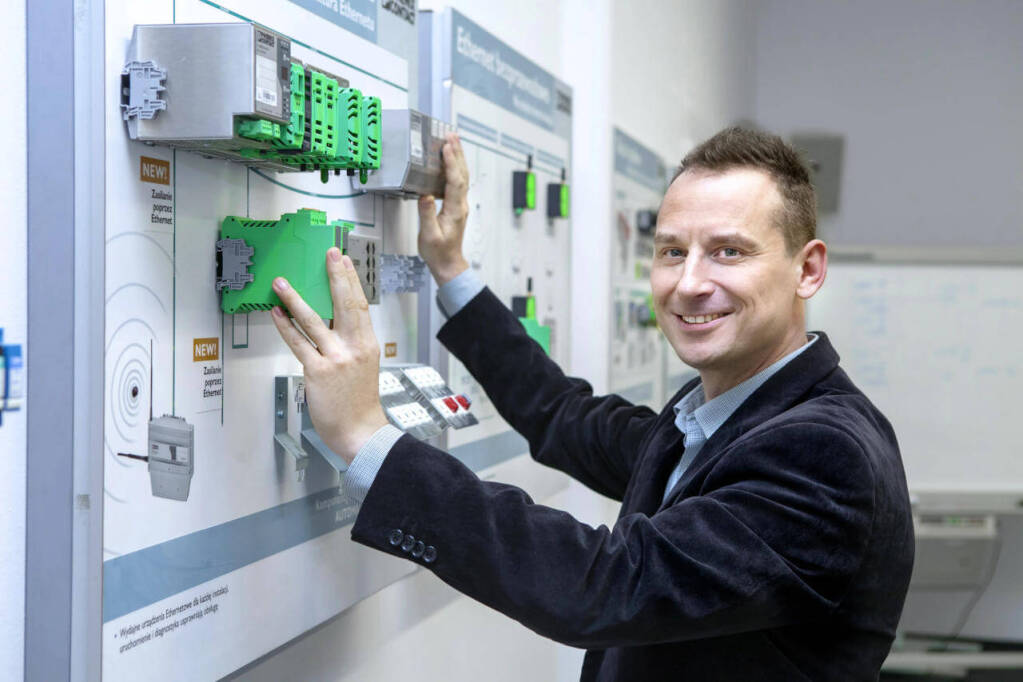
Grzegorz Dobry, Office Sales Manager, Phoenix Contact
Significantly speeding up the delivery of the invoice and information about the receipt of the document by the recipient also has a positive impact on cashflow in the organization – there are fewer invoices that do not reach the addressee
Invoices are a special example of electronic documents, since the possibility of implementing their exchange electronically is subject to additional legal requirements. These primarily include ensuring the authenticity and integrity of the content of the document, i.e. confirming the sender of the document and securing the transmitted data against alteration. The communication realized through Edistrada in accordance with the EDI standard is indicated directly in the regulations as a form of transmission of electronic invoices, guaranteeing the integrity and authenticity of the sent document.
Secure document archive
The life of a paper document does not end when it is sent. Such a document must also be archived and stored for the period required by law (in the case of e-invoices, this is 5 years, counting from the end of the year in which the return was filed). With the traditional method, then, comes the need to maintain and manage an archive of documents. Fortunately, this component can also be digitized. One of the optional components of the Edistrada platform is the e-invoice archive, which removes the obligation for contractors to keep documents with them.
Both the e-invoice archive and Edistrada’s servers are maintained at All for One Data Centers, where the systems are cared for by high-class specialists. “The operator of electronic document exchange is by no means virtual – we had the opportunity to audit All for One Data Centers, where Edistrada’s servers operate, and we must admit that we are very impressed by the professionalism of the service implementation. We found a professional data center, meeting all standards and bearing the necessary certificates. Security issues and ensuring the continuity of the service are very important to us, so we pay special attention to this." – says Grzegorz Dobry.
All in the portal
Access to the repository of electronic documents can be realized through a web portal, another component of the Edistrada service package, which meets the legal requirements for the transmission of electronic invoices. Through the portal, the condition of providing the tax authority or tax inspection authority with access to the repository of electronic invoices on request can be realized.
The use of the portal greatly facilitates the management of electronic communications. The main distinguishing feature of the web portal used by Edistrada is its intuitive operation and very high speed.
Grzegorz Kupczak, Director of Electrical Engineering, Alfa Elektro
Access to the electronic document archive can be provided through a web portal, which is another component of the Edistrada service package
Errors in electronic communication are a much rarer phenomenon than in the process of traditional document exchange, where a document passes through many hands on its way from system to system. However, a system is only as strong as its weakest link, so handling these errors should also receive attention.
“The use of the portal greatly facilitates the management of electronic communications. Using a web browser, it is possible to track all documents related to a given order, such as confirmations and invoices, among others. The main distinguishing feature of the web portal used by Edistrada is its intuitive operation and very high speed," stresses Grzegorz Kupczak, Director of Electrical Engineering at Alfa Elektro.
Filip Bochenek, Sales Director at CP Trade, adds: “Information like: ‘error 0002 occurred’ tells the user nothing. In the Edistrada portal, we can follow the steps of the process in detail, and if an error occurs, we have a clear indication of whether the document has an error in the structure or whether there was a problem with the connection. This allows us to immediately determine whether corrective action should be taken by the sender, recipient or service provider. This clearly improves response to unforeseen situations and communication between contractors when resolving problems, especially since such information can also go to a selected e-mail address, indicating, for example, the exact location of the error in the file."
In the Edistrada portal, we can follow the steps of the process in detail and if there is an error, we have a clear indication of whether the document has an error in the structure or if there was a connection problem.
Filip Bochenek, Sales Director at CP Trade
Lower costs, less time-consuming
“All of these benefits translate directly or indirectly into cost reductions." – Grzegorz Dobry emphasizes. – “The easiest to measure, of course, is the cost associated with handling the document shipment, that is, paper, printing and shipping costs. But it doesn’t stop there, because the labor intensity of handling such a process has also decreased significantly, and this is true both on the side of the sender and the recipient of the document. Time spent repeatedly entering document data into systems and time spent managing correspondence or document archives is now used for more challenging tasks, and handling the process on both the business and IT sides is less involved thanks to automation, outsourcing of the service and reduction of errors. Significantly speeding up the delivery of the invoice and information about the correct receipt of the document by the recipient also has a positive impact on cashflow in the organization – there are fewer invoices that do not reach the addressee, and in case of a communication error we find out about it right away."

Steps of document processing with status information
Each document sent electronically is at least a few zlotys of savings. If a company sends several hundred documents in a month, the savings go into thousands of zlotys. Among our clients there are also companies that send tens or even hundreds of thousands of documents per month and thus save hundreds of thousands of zlotys, and on a monthly basis! These are not all the benefits of Edistrada.
Automating and recording communication data electronically also opens the way to the possibility of analyzing this data and building new tools, such as SelfCare portals or B2B platforms – and gaining further benefits behind it. The launch of electronic document exchange is also a perfect example of green action, and there are no losers here – everyone gains.
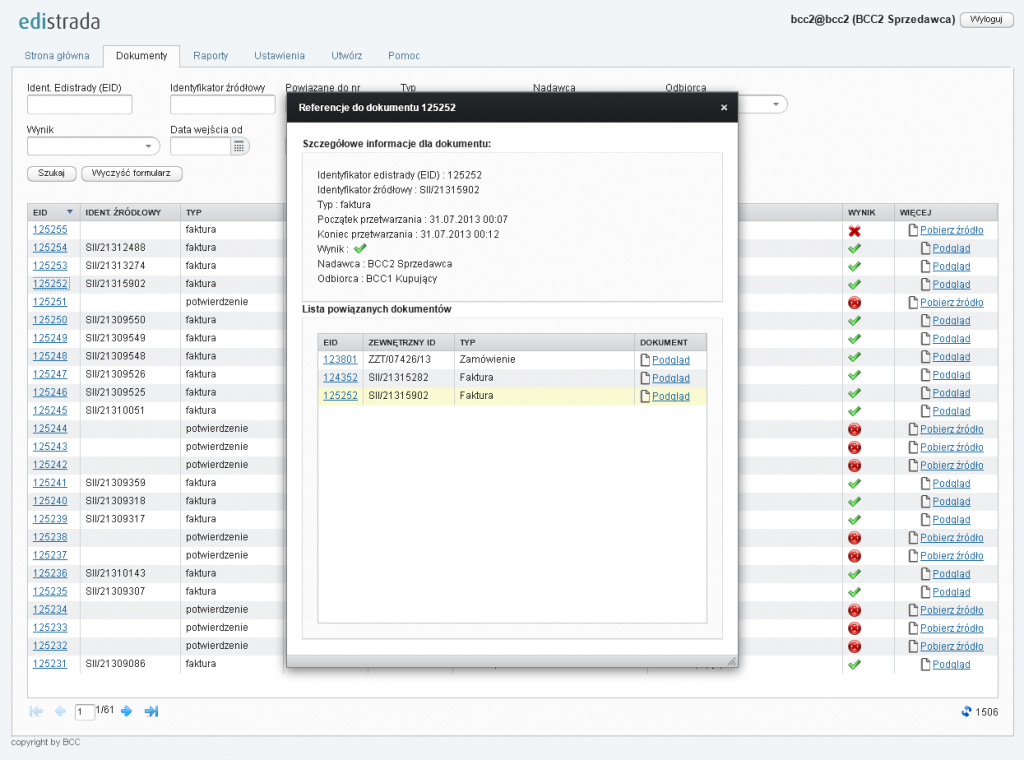
History of related documents (possibly can be deleted if you run out of space
Step by step
The recommended practice for implementing EDI platforms is a phased approach. It is worthwhile in this type of project to define a group of selected business partners and verify the operation of the service with them, only in the next stage should the scope of the service be extended to all contractors and think about the implementation of sophisticated functionalities. This will allow you to see what challenges can be encountered when linking an IT system with an EDI operator, and confirm the effectiveness of the intermediary platform itself.
The chosen platform should allow the configuration of a secure and universal connection, which can then be used with subsequent contractors, without repeatedly incurring unreasonable costs for contractors already connected. It is also very important to be able to verify the status of the transmitted document, e.g. in a web portal, and to report errors in detail.
From the point of view of an EDI service provider, this approach when implementing in a new industry is also beneficial – it allows us to understand the specifics of the industry. The first group of electrical engineering companies covered by Edistrada’s service provided us with many valuable insights, which we are using in subsequent implementations. We see similar relationships in other industries as well.
It is intended that communications operating according to a specific standard, such as EDIFACT, should not depend on the industry of contractors, but often the use of the standard has its own specifics in a particular branch of business or on the territory of a selected country. Edistrada is prepared to take such specific dependencies into account, paying special attention to ensure that the scale of system adjustments does not adversely affect the efficient operation of the entire service. This is possible thanks to the well-thought-out architecture of the platform, which is built to provide maximum flexibility in reflecting the business processes of our customers. In this way, it is possible to accommodate changes in the standard, natural to the client, and to extend functionality at the client’s request at a reasonable cost.
Flexibly for big and small
BCC (now All for One Poland) has extensive experience with EDI processes, gathered over the years, initially mainly as a SAP system integrator. Since the early EDI projects in Poland, we have been building interfaces with the system, creating translation maps, writing communication programs, connectors to SAP, as well as using off-the-shelf SAP integration platforms and extending their functionalities. We have knowledge of EDI processes from the point of view of the system, and therefore the customer. In doing so, we have worked with many different EDI operators in Poland and around the world and have had the opportunity to learn about different integration platforms and face many problems together.
Edistrada in SaaS
The Edistrada platform is provided in the Software as a Service (SaaS) model, based on the infrastructure of the BCC Outsourcing Center, which translates into secure and reliable communication. The transmission of documents is carried out through a central EDI system, which is maintained at the BCC Data Processing Center, which ensures a high level of security and continuity of operations, regardless of the volume of data transmitted.
The BCC Outsourcing Center has high-end infrastructure and organizational solutions, operating in accordance with the strict ISO 27001 standard for information security management. The correct operation of the Edistrada platform is supervised by BCC specialists. Maintaining the system, ensuring the continuity of its operation, as well as archiving data and systematically making security copies, is the responsibility of BCC as the EDI operator.
Before developing our own integration platform, we did a thorough analysis of the possibilities of using the tools and services available on the market at the time, which allowed us to gather a set of the most common pain points in implementing and maintaining the operation of EDI processes. We heard about the problems of contractors in adapting electronic documents to the standard and the lack of flexibility of services available on the market.
This approach on the part of EDI operators is somewhat understandable – ideally, everyone should use one standard. However, it closes the way to launching electronic communication (in any form) for many smaller companies, for which adapting their IT systems is a major cost that is not justified by the scale of communication with contractors.
We therefore decided to provide a wide range of connectivity, so that each of our client’s contractors would be able to launch electronic communications, if not in accordance with the EDI standard, then at least based on a web portal or even an e-mail service. We recommend, of course, setting up an online connection with Edistra, preferably based on REST web services, so that there are no unnecessary delays in communication and that status and error information works better.
The possibility of preparing such a connection is of interest to many companies, especially those that have high-end IT solutions and have their own team of IT specialists. However, where systems have their limitations, communication based on file interfaces and even documents in Excel files sent by e-mail is possible.
In addition to flexibility, the advantage of the Edistrada platform is its low cost – both in terms of implementation and maintenance. Our goal is to encourage as many customers as possible to launch a test connection, so that the network of business relationships is gradually reflected in the EDI connection network.
In the electrical engineering industry, for example, each of the initially connected contractors now connects independently with subsequent ones. As it turns out, the business partners of the companies in the first group of deployments also have business relationships with each other, e.g., they buy electrotechnical components from which they assemble their products, then sell them to distributors, who in turn also have the components themselves on offer.
In this way, Phoenix Contact, which initially sent a few dozen documents a month via Edistrada, has gradually increased the scope of its communications, so that it now sends thousands.