

SAP systems in Forte play a key role both at the production stage (PP, MM, QM, WM modules), as well as in sales processes (SD), financial services (FI, CO) or human resources management (HR). Key business decisions are also supported by the SAP BW data warehouse.
Over the past 13 years, since the system was implemented, many adjustments have been made so that it fully supports the operation of complex business processes. Among them, for example, are dedicated tools for production control.
Today, the manufacturing system SAP ERP is nearly 2 TB of data and about 400 users working from several locations.
System maintenance and development is handled by Forte’s own IT team, supported by specialists in SAP and the IBM iSeries technology platform, among others. Their priorities include maintaining the smooth operation and high availability of SAP systems on a 24-hour basis.
AS for SAP
The history of using the IBM iSeries platform (formerly known as AS/400) goes back further in Forte than SAP. Already the previous system was installed on it, and the possibility of running SAP on iSeries was, besides business reasons, one of the reasons for choosing it. When implementing SAP, it was decided to use the previously accumulated competencies of the IT team.
The i5/OS operating system installed in the IBM i-series platform has no equivalent in the offerings of other software manufacturers, as is the case, for example, in the Unix systems environment. All the more valuable and unique are the competencies associated with it.
Although it is not a popular platform for SAP systems, Forte appreciated its high stability, security and integration of the database and operating system. The fact that the platform has been on the market for more than 20 years and has been consistently developed by IBM all the time was also significant. And SAP systems have been associated with IBM solutions from the very beginning.
New servers and operating system
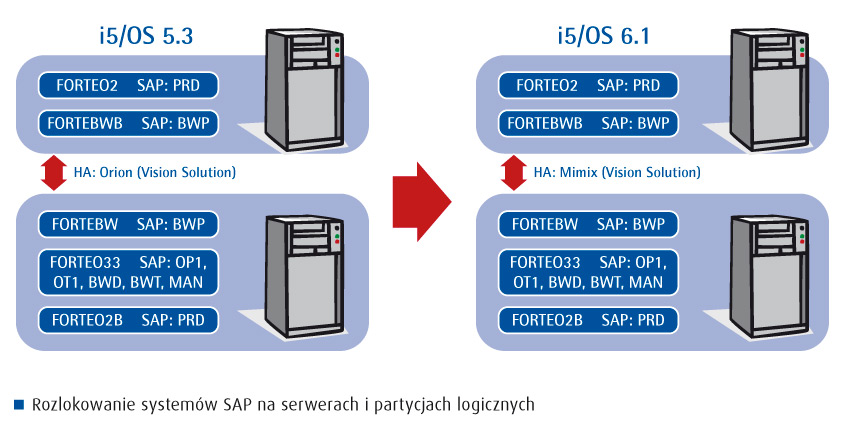
In late 2010, Forte decided to replace its existing hardware platform based on two IBM i5-520 servers with seven logical partitions and i5/OS version 5.3 with two IBM Power 720 servers with OS version 6.1.
Hardware replacement was dictated both by the end of the manufacturer’s support period and by performance considerations. Increasing with system size and data growth, the average system response time was approaching a value that posed a threat to the efficiency of business process handling.
BCC (currently All for One Poland) was responsible for the entire SAP systems work, i.e. migration, performance testing, refreshing the test and development systems, and migrating the contents of the CommonStore archive. Crede Experto, a company specializing in iSeries solutions, was the supplier of the hardware, operating system and high availability solution (Vision Solution).
Analogous to the servers used so far, using the functionality of partitioning physical hardware into logical units, nine logical partitions were located on the two new servers, including five for SAP systems.
SAP ERP and BW test migrations
From the beginning of the project, the main focus was on optimal preparation for the migration of the production SAP ERP system due to the strictly defined service window during which the system could be taken out of service. Therefore, a test migration of the production system was performed first.
The migration of systems was based on SAP-supported homogeneous copy methods, in which data from the source system is recreated and converted on the target platform, and the environment is prepared at the operating system level (users, binaries, permissions, etc.), adapting it to the new version of the operating system.
Due to the significant size of the database (2 TB), the restoration and conversion process required close cooperation between BCC, Crede Experto and Forte’s IT team to optimize it.
The first test migration of the system was successful, with the system running properly on the new platform. However, this test simultaneously showed that, on the hardware side, it was necessary to verify and adjust the way disk resources are shared for the partition of the production ERP system. Appropriate changes (abandoning disk sharing through the host partition) were made to the hardware configuration by Crede Experto.
After the changes were made, it was necessary to conduct another test to accurately estimate the time needed for the final migration of the production system. Such a test was performed, and based on it, a detailed work schedule was built for the final migration of the production ERP system.
The next step in the migration project was a test migration of the production SAP BW system. As with the ERP system, in addition to the need to confirm that the migration process was proceeding correctly, an important goal of this test was to accurately estimate the time required to complete the various steps. Furthermore, it was necessary to combine the BW system migration schedule with the ERP system migration schedule, since both systems were being migrated at the same time. In addition, it was necessary to take into account the steps required to configure a high availability solution.
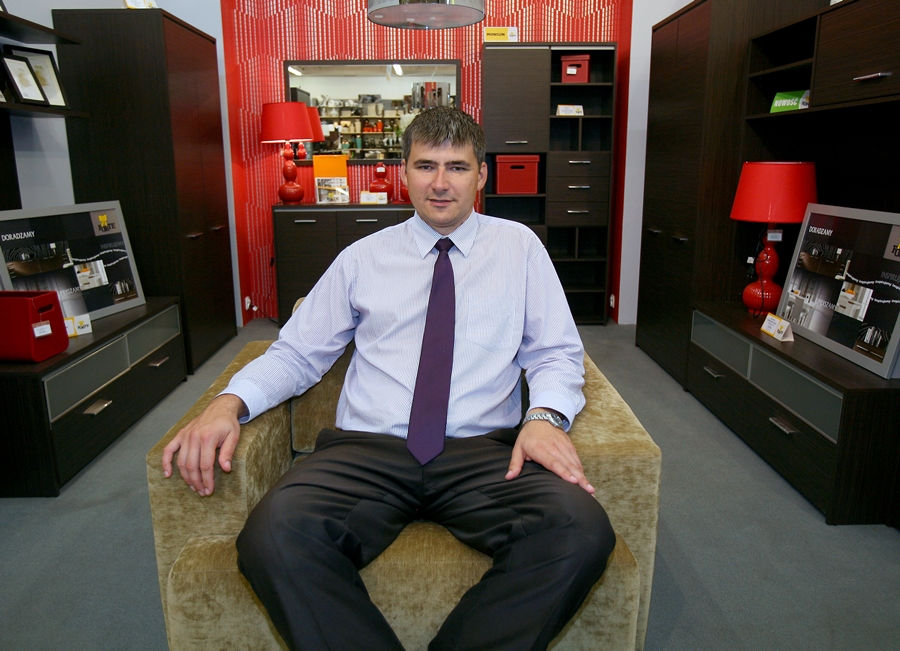
Tomasz Krawczuk, Director of Project Management, FORTE Furniture Factory
We focus on the quality of IT services
FORTE is a dynamically growing company with large IT needs. At FORTE Group, we focus on the quality of IT services as well as their adaptation to business needs. Migration to a new hardware platform is one of the steps towards continuous improvement of the quality of service provided by the IT department. As a result of the migration, we have achieved several times lower system response times, which translates into efficiency and comfort for the end user. The biggest challenge in such projects is to ensure the continuity of the system’s operation – a good schedule and perfect preparation guaranteed the success of the project.Tomasz Krawczuk, Director of Project Management, FORTE Furniture Factory
Test and development environments
The plan prepared in this way was the basis for the final migration of production systems.
The migrations of test and development systems that were carried out were also not insignificant in planning the migration of production systems. The experience gained during this work allowed even better preparation of the final migration of production environments.
Changing the hardware platform is a good opportunity to “clean up" the SAP environment, so Forte decided to refresh the test and development ERP system from the production system. Such an operation made it possible to align the repositories and configuration of the ERP systems.
In addition to the test and development ERP systems, the BW systems (test and development) and the Solution Manager solution were also transferred. In addition to the ABAP part, these systems also included a JAVA part (the so-called duble stack).
Performance most important
The Forte IT team’s experience from previous similar projects indicated the need to confirm the performance of the new platform even before making it available to users. Therefore, performance tests were scheduled after the test migration of the production ERP system.
It was decided to build a simple mechanism to confirm that the system would also work efficiently during periods of increased load, which happens, for example, at the end of the month. It was assumed that the tests would be performed only once, so it was not decided to purchase a dedicated solution. It was decided to use the mechanisms available in the SAP system – the e-Catt tool was chosen.
A few key, most frequently performed business operations were selected, and then test scripts were built. The scripts prepared in this way were run from multiple workstations, thus simulating intensive user work and heavy system load.
During the tests, the system’s work and load were verified on an ongoing basis. Performance statistics were then analyzed – the results were not objectionable, the platform works efficiently.
Archive back in the system
Somewhat incidentally to the project, BCC consultants also migrated the contents of the IBM CommonStore archive (from DVDs) to the IFS file system. It was found that with the current cost of disk space, it would be more efficient to store data directly on disks. Especially since the solution used to date was no longer supported by IBM, and upgrading it would involve additional costs and labor.
24 hours and 15 minutes without SAP
After a period of preparation and migration of test and development systems, it was time for the final migration of production systems. The timing was dictated by business considerations. It was not easy to find a weekend when the system could be shut down. The entire work was allocated 48 hours and 45 minutes, of which the production SAP system could be shut down for only 24 hours and 15 minutes. The schedule, developed on the basis of previous tests, was fixed to the minute:
- We begin on Friday at 1:30 pm with the shutdown of the production BW system and the backup of the entire partition (the so-called “entire system" backup);
- The next step is to recreate the database and IFS files on the new server;
- then we make system adjustments to the new platform: data conversion, SAP kernel upgrade, J2EE environment adjustment, etc.;
- 7:45 a.m. on Saturday, the first startup of SAP BW on the new platform takes place (with background tasks disabled so that the system does not communicate with other systems);
- We check the system and find that it is functioning properly;
- After checking, we shut down SAP BW again and the high availability (HA) configuration preparation stage follows, including: backup of the “new" system and restoration on the second partition, which acts as a backup partition in the HA configuration;
- 3:15 p.m. Saturday, the BW system is ready for production launch;
- 2 p.m., in parallel with the concluding work on the BW system, we begin work on SAP ERP by shutting it down and performing an “entire system" backup;
- Analogous to the BW system, we recreate the database and IFS files;
- we perform system customization for the new platform: data conversion, kernel upgrade, etc…;
- 11:50 p.m. Saturday, the first launch of the production ERP system (with tasks disabled) on the new platform takes place;
- We check the system and find that it is functioning properly;
- time to set up high availability (HA): backup, restore to a second partition and verify the HA mechanism;
- 08:45 a.m. on Sunday, SAP ERP and SAP BW system start production, but without user access yet;
- the systems check stage follows, involving key users from each module;
- 2 p.m. Sunday, systems are up and running – key users along with Forte’s IT team confirm that SAP systems and their communication with other systems are working properly; decision to launch;
- 2:15 p.m. Sunday, the first users begin regular work with SAP systems.
The next few days were spent carefully observing the system for possible problems. We paid particular attention to performance. We were pleased to find that the average response time of the system is at 0.25 seconds, which is more than 3 times shorter than on the old platform – the goal has been achieved.
More than 30% of FORTE’s products go to customers in Western and Central Europe, as well as Eastern markets. In total to the inhabitants of more than 30 countries of the world.
The basic products are: kitchen and chest furniture, for furnishing living rooms, especially living rooms, cabinets, bedrooms, dining rooms, furniture for arranging offices, workstations (computer), conference rooms. In addition, furniture for youth and children’s rooms is produced, as well as systems for hallways.