


SAP SuccessFactors - employee at
center
A system for the people, not just the company
If we put together the most frequently cited reasons why companies opt for SAP SuccessFactors, we get a fairly predictable list: process integration, modern interface, cloud, mobility, artificial intelligence... These arguments are true and valid. But there's also the other side of the coin: how SuccessFactors addresses the human and organizational challenges that HR faces every day. And these - regardless of the industry - are surprisingly numerous.
If we put together the most frequently cited reasons why companies opt for SAP SuccessFactors, we get a fairly predictable list: process integration, modern interface, cloud, mobility, artificial intelligence... These arguments are true and valid. But there's also the other side of the coin: how SuccessFactors addresses the human and organizational challenges that HR faces every day. And these - regardless of the industry - are surprisingly numerous.
Moments that mean
As employees – like the proverbial goldfish – we quickly forget many things. Fortunately, we remember very well the moments that evoked emotions in us: our first day on the job, onboarding, feedback from a co-worker, annual appraisal, or finally – offboarding. In HR, they talk about “moments that matter" (moments that matter) and this is where SuccessFactors shows its strength. The onboarding module allows the employee to enter the organization even before he or she physically crosses its threshold: meet the team, watch the CEO’s welcome video, read the supervisor’s message, see the implementation plan. These aren’t little things – it’s building an emotional relationship with the company from day one.
Likewise with offboarding. Saying goodbye to an employee is closely watched by those who stay, affects the employer’s reputation and builds a community of former employees (“employee alumni network").
Positive feedback from co-workers is also memorable. SuccessFactors even builds a culture of feedback. It addresses our need to be appreciated, but also reinforces those activities that are important to the organization and worth repeating. Let’s honestly answer the question of how often we express appreciation to other employees, especially now, when building relationships within the company due to the hybrid work model is difficult.
In the SuccessFactors system, thanking an employee for help, active participation in a project, or a well-conducted meeting is a matter of a few clicks. The so-called badges that are visible in an employee’s profile may look like a minor gamification add-on, but in reality their psychological importance cannot be overstated. The need for recognition is one of the strongest social needs at work. Badges satisfy it in an immediate and lasting way, moreover, they help break the invisibility at work.
In his book “Drive," Daniel Pink identified three pillars of motivation 3.0: a sense of mission, autonomy and the pursuit of mastery. This is the motivational potential of so-called dynamic teams. They are the ones that offer employees a sense of purpose (mission), give them the most autonomy in project execution (members are not constrained by the corset of procedures or formal methodology) and allow them to grow. Dynamic teams introduce “flow" (after Mihaly Csikszentmihalyim): A state of full involvement in a task of high value and difficulty matched to competence. Participation in the work of such teams provides a sense of agency and shared responsibility for the outcome, reducing the so-called “agency" effect (“it’s not my decision, so I’m not responsible for it").
SAP has rightly recognized that SuccessFactors’ support of dynamic teams is an important part of the system and worth investing in. Dynamic teams at SuccessFactors are formed around initiatives that employees volunteer to join. Out of passion, curiosity and a desire to grow. From the organization’s point of view, it’s a cheap and effective way to mobilize energy that can’t be decreed by structure or KPIs.
The paradox of promotion
In many organizations, promotions are impulsive. Someone leaves? We promote the best specialist. The result is sometimes painful: we lose a great expert, gain a mediocre manager and a frustrated team. The problem lies not in the people, but in the career system, which: promotes only vertical promotion, does not recognize potential, does not give space for expert paths, does not offer people autonomy and does not plan succession strategically.
SuccessFactors helps defuse this paradox. First, it invites employees to talk about the future. Growth portfolios allow employees to talk about aspirations before vacancies and decision pressure sets in. Employees don’t get the promise of a promotion, but they have a voice and an opportunity to prepare for their future desired role.
Second, succession planning allows an organization to act in advance. Instead of reacting ad hoc, we build a pool of successors. We know who will be ready and when. Ultimately, we have fewer random decisions and a better chance of getting the right people into the right positions.
SAP SuccessFactors - a new level of interaction with employees
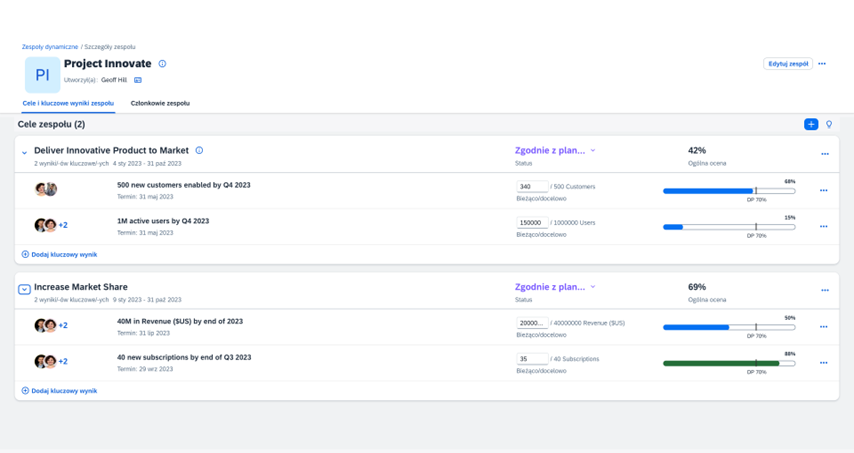
Participating in a dynamic team gives you a sense of "flow"
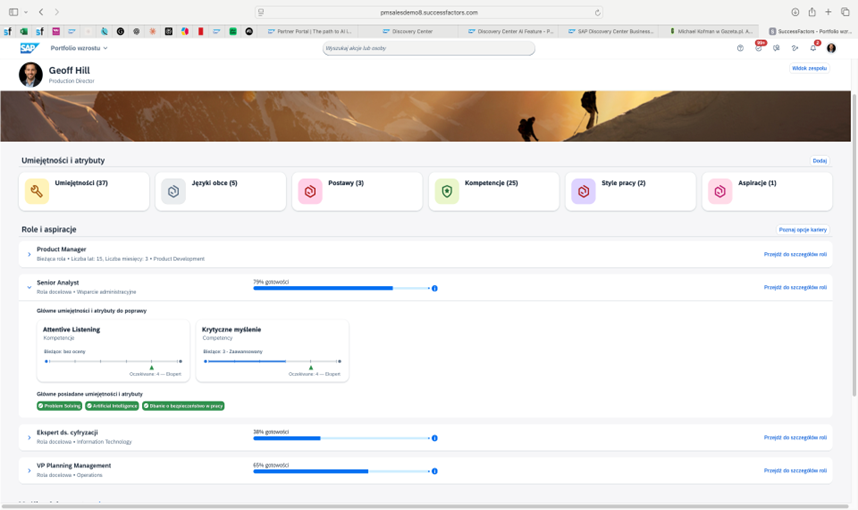
Growth Portfolio invites employees to talk about their development
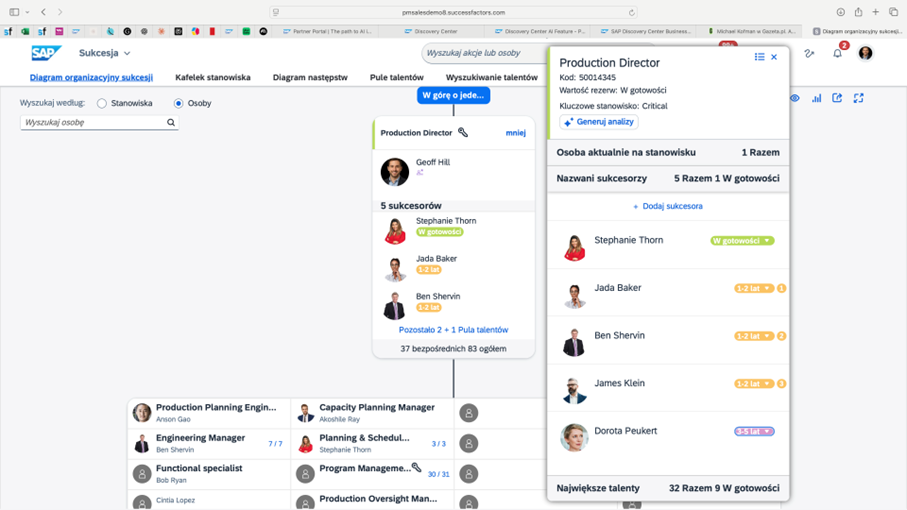
Succession planning allows an organization to act proactively
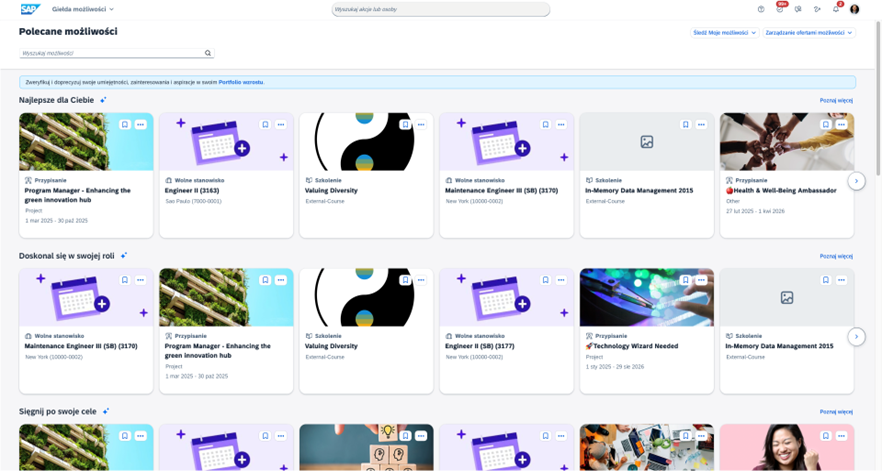
Opportunity Marketplace – for development opportunities
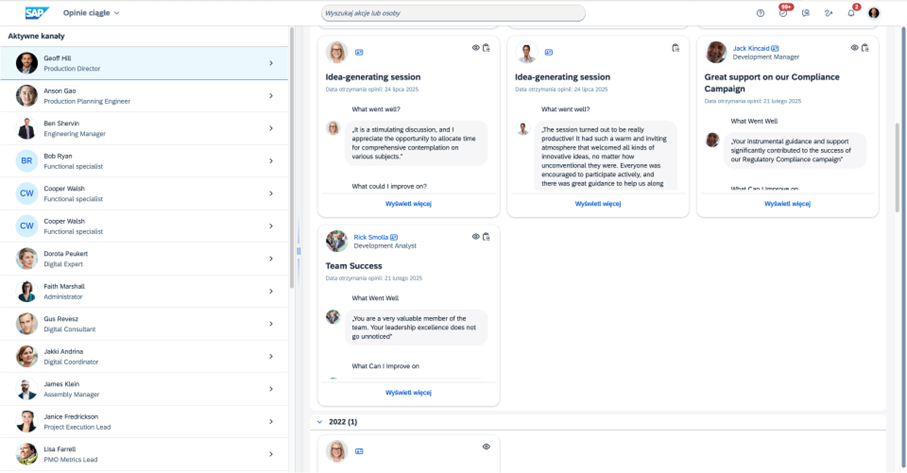
Feedback from colleagues - SF builds a culture of feedback
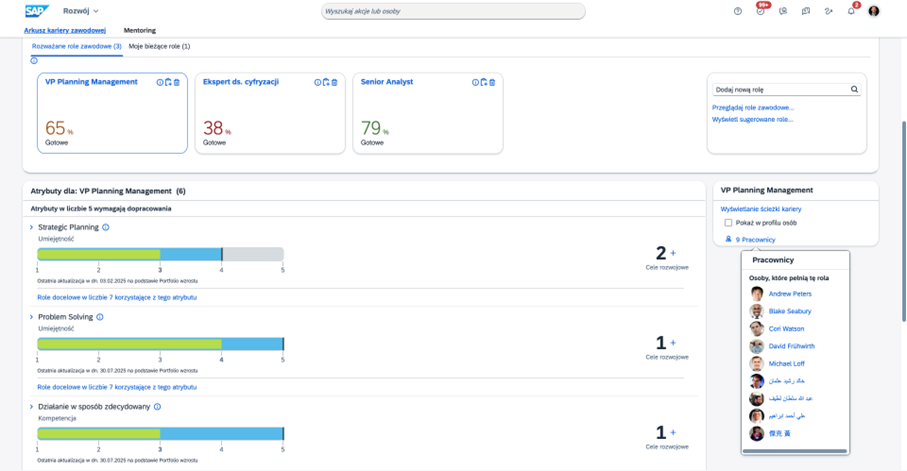
Thanks to career sheets, the employee sees people in similar roles
The paradox of the "open bar" in development management
Who among us hasn’t encountered a situation where, at a party with an open bar, someone has gone overboard in trying liquor? This is perhaps a somewhat clumsy metaphor for what happens with some training systems. Having access to hundreds of training courses sounds great – until it turns out that employees don’t know where to start and HR doesn’t see results. It’s the classic “open bar" paradox: since everything is available, we take too much and without thought.
The paradox is that if we give employees too much unstructured training, development effectiveness drops. Access to hundreds of training materials is not a development strategy. It is an illusion of development. The more options, the less real engagement. SuccessFactors’ Opportunity Marketplace brings order to this chaos.
The employee doesn’t get everything – he gets what makes sense in his context: training, mentoring, projects, roles, dynamic teams. And when artificial intelligence is added, recommendations are no longer generic. SuccessFactors personalizes development so that everyone gets exactly what really develops their talent, instead of a random “open bar."
The paradox of scale
In theory, the more people and potential contacts we have at our disposal, the greater the chance that we will find a person with the desired competencies. In reality, in large organizations it is paradoxically more difficult to access knowledge and people. Competencies are “somewhere," careers are “next door," and networking tends to be theoretical.
SuccessFactors brings order to this chaos. With career sheets, an employee can see people in similar roles, check their career paths and easily make connections. In mentoring, the system suggests the best-fit mentor – not randomly, but contextually.
The paradox of choice and the power of best practices
Barry Schwartz, in his book “The Paradox of Choice," showed that an excess of options leads to decision paralysis and frustration (even after a choice is made). During IT implementations, there is a risk that teams get bogged down in lengthy analyses and ultimately lose the goal of the project. With SuccessFactors projects, we take a different route. We get a set of “best practices" (best practices) and a preconfigured solution. Instead of designing everything from scratch, we go through an exploratory phase: we review the processes, test them and define only the necessary deviations. This is not a limitation – it’s freeing up energy for what really matters.
Why SuccessFactors?
SuccessFactors is not another HR system that “handles processes." It touches on challenges that organizations have known about for a long time, but rarely address: how we really motivate people, how we make promotion decisions, how we handle excess choices, and how we manage scale without missing the point. And that’s why SuccessFactors is beginning to serve as a platform for changing the way we think about working with people – more informed, less impulsive and better grounded in the realities of modern organizations.