

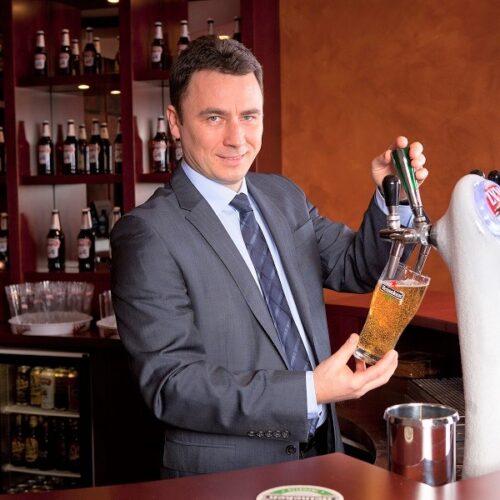
What are the largest IT-related projects recently underway at the Zywiec Group?
G.J.: The years 2011-2012 in Żywiec Group are a period of implementation of the largest business project in the company’s history, aimed at reorganizing business processes and implementing a new SAP system. The new, more comprehensive and advanced solution is to replace the previous one, which was based on combined SAP and DyNAMICS solutions.
Looking at the scope of this project, it can be said that 14 initiatives are being implemented in parallel, touching all functions and departments of the company with their scope. The implementation areas covered are the processes of market service, sales and distribution, finance, supply chain, including production, and broadly defined “business intelligence."
Each of the aforementioned areas requires the implementation of different tools and systems. Therefore, in addition to a wide range of SAP ECC modules supporting finance, sales, production, purchasing or warehousing, our project includes the launch of mobile systems for sales representatives, drivers and food service technicians. There are also tools to support customer billing management processes and SAP CRM modules with telesales and promotional campaign management functions. To support transportation planning processes in distribution, we decided to launch ORTEC LEO tools. The last initiative is the implementation of a new SAP BW data warehouse to provide integrated reporting through a well-organized data repository.
What areas of SAP solutions do you consider most important from the company’s point of view?
G.J.: Due to the fact that all of our SAP-related initiatives are implemented as part of a single integrated project, it is difficult for me to pinpoint the most important area. In our initiatives, we are dealing with interconnected vessels. Each “link" of the project provides specific benefits to the company. Take, as an example, the mobile sales representative system, which in itself provides salespeople with the ability to serve the customer at the point of sale and pass the order directly to distribution. It is important because it allows us to schedule visits to the market for several hundred salespeople and provides a source of order acquisition, but it is no longer responsible for order fulfillment. It is only when the delivery is made and the VAT invoice is issued by the mobile system that we can talk about effective sales.
Therefore, each initiative included in the scope of the project is equally important, although the scale of the challenges faced by each is different. Most of these challenges are in the area of distribution and sales, where business processes have so far not been supported by SAP systems. A skillful implementation in this area will determine the success of the entire project.
Is there an organizationally separate Project Office in the Zywiec Group?
G.J.: Looking through the prism of this project, we can consider that the Żywiec Group has organizationally separated the Project Office. The responsibilities of this office include planning and coordinating activities between project teams, prioritizing the implementation of necessary organizational changes – the so-called “change management", managing human resources dedicated to the project and the training system for future users of the new systems.
All this allows for effective use of the budget of the entire investment. In retrospect, it can be seen that the decision to establish such an organized organizational unit allowed for efficient management of the implementation process and will provide a good basis for further development of the “Project Office" of the Żywiec Group.
Do you have developed general patterns or practices for running projects in the Heineken Group? To what extent does this translate into standards for running projects in the Zywiec Group?
G.J.: The management of business and IT projects in the Żywiec Group is carried out according to standards developed globally for the entire Heineken Group. The methodology is based on proven elements of the PRINCE2 project management methodology. The facilitation we receive in the Heineken Group standards is the adaptation of individual project management elements to our industry and its specifics, the use of support tools, and, most importantly, the indication of decision-making processes in the project in relation to the organizational structure and dependencies between the company operating in a given market and the Heineken Group headquarters in the Netherlands.
What does the transfer of SAP project management knowledge look like in the corporation – how does it “physically" happen, who is involved?
G.J.: The transfer of project management knowledge occurs through training. However, training is only an element of theoretical preparation, which must be supported by practice. There are many international initiatives in the Heineken Group, where practical knowledge transfer takes place through co-participation. In addition, for such large projects as ours, the management team consists of experienced managers from the Żywiec Group and Heineken’s headquarters. Such a solution guarantees proper knowledge transfer and gives security to the project.
Does the experience of the Zywiec Group’s projects influence project standards in the Heineken Group?
G.J.: I have been working in the Zywiec Group for many years, and I know from experience that there are lessons from each project for each of the parties involved. The best practices applied during each project are the basis for learning lessons and modifying standards, both in terms of management and the project tools used. We have many achievements here. Examples from our project include a new tool for assessing the state of project readiness before ‘Go-Live’ or a tool for managing and communicating changes in business processes in an organization, the so-called ‘change management’.

Grzegorz Jaworek – Project Director, Żywiec Group
Grzegorz Jaworek – Director of Projects at Żywiec Group. He started his professional career in 1995, taking the position of ICT Manager at Warka Brewery. In 1995-2002 he was responsible for the brewery’s computerization, implementing modern ICT technologies and an ERP system. In 2002, he accepted an offer to create and lead the development and sales support department of the Żywiec Group. His responsibilities included building a sales analysis and administration team and introducing CRM solutions within the Żywiec Group, the scope of which included sales automation, trade marketing and marketing and the use of business intelligence tools. In 2008, he led one of the largest consolidation projects within the Żywiec Group, the merger of 13 distribution companies of Żywiec Trade with Żywiec Group SA. In 2009-2010, he led several large commercial projects, one of which involved building organizational and process structures for the currently operating Żywiec Group Customer Service Center. He is currently implementing an integration project focused on the processes of all functions and departments of the company and the implementation of SAP ECC and CRM.
What is the design language at the Zywiec Group?
G.J.: The project language is English. This is due both to the methodology of project implementation, which involves functional consultants from headquarters every time, but also to the need to agree on necessary local changes in business processes with their owners for the entire Heineken corporation. This, of course, poses many challenges, especially when, as in our case, nearly 130 people from 16 countries are working on the project.
Who is involved in SAP projects at your company – how much is the IT department and how much is business people, what kind of people are they?
G.J.: In our company, SAP implementation is not treated as an IT project. It is a business project, which results in the implementation of SAP tools and system. Therefore, the project teams are mainly based on people from the business, i.e. departments other than IT. Each work team is led by a business process chief (BPO – Business Process Owner), supported by one or more key users (KU – Key User). In each work team we have IT consultants from the Zywiec Group and from Heineken. I must emphasize that to implement such a large project in many business areas, the BPO is delegated 100%. I believe in the principle that only with the full level of involvement of employees from the business, we can talk about a real business project and carry out the organizational changes necessary for implementation.
How can business people make an impact on SAP solutions, e.g., having ideas for innovations, changes in the system; having new expectations?
G.J.: In our definition, SAP implementation is treated as a business project, because the system is for the business, not the other way around. It is the business staff that describes the processes, and then, in cooperation with IT consultants, defines the proper functionalities of the system. In the absence of a given function in the SAP standard, the process of creating them begins. However, always in accordance with the requirements of the business process.
A good example from our experience is the process of “cash collection and settlement" by delivery drivers in traditional trade. In our industry, cash payments at delivery are not uncommon, and the solutions available under SAP standards did not meet our minimum requirements. It was thanks to close cooperation between business and IT that we were able to deliver solutions that are now standard not only in the Żywiec Group, but throughout Heineken.
How much does the Board of Directors get involved in SAP projects – in which and in what form?
G.J.: Without the involvement of the company’s Board of Directors, it is impossible to talk about treating SAP implementation as a business project. It would also be difficult to get quick approval for necessary changes in processes and sometimes in the organizational or legal structure. In our case, the Board offers support from the very beginning of the project. The entire Management Board of the Zywiec Group and representatives of Heineken’s headquarters constitute the Steering Committee of our project. Regular meetings with the company’s Management Board allow full control and keep the company properly mobilized for its implementation. For me, as the head of the project, it is important that I can always count on the decision-making support of each member of the Board, and in situations that require it – an ad-hoc meeting.
To what extent does the industry specificity of the producer of Zywiec and Warka, among others, influence design practices?
G.J.: The specifics of our industry have a direct impact on design practices. This can be seen, for example, in the availability of employees during the summer, when the highest sales take place. The seasonality of beer sales also sets a time frame for the project in which we can implement ‘Go-Live’ strategies for new processes and systems.
What is the scale of personal involvement in the SAP project?
G.J.: Nearly 130 people are directly involved in the project. Nearly 80 represent all functions of our company, and nearly 50 are representatives of Heineken headquarters and external partners. The project team in the periods preceding the launch of the various phases of the project is expanded with a coaching team, which trains several thousand end users. At the peak of the implementation, the project team, including the coaching group, numbered 220 people.
What does the appointment of project team members look like. What are the main criteria?
G.J.: The appointment of project team members is key to the subsequent implementation and success of the project. You cannot afford to delegate people to this type of project from so-called “chance". Before starting, the project manager meets with key business leaders and discusses the scope of work and responsibilities of future implementation team members. In addition to English language skills, the candidate must know the business processes of the function or department in detail, understand the so-called “end-to-end" process and be well versed in project management principles.
How is communication organized in the project, especially in international projects? Are there barriers not so much linguistic as cultural? Do you have to deal with the so-called second, informal circulation of information in projects?
G.J.: Communication in any endeavor is a challenge, let alone in a project of this magnitude. Well-organized communication channels are an essential part of the entire implementation, both internally for the project team and externally – for the entire organization where the project is implemented. The basis of good communication is its plan, so at the very beginning of the project it is necessary to identify all stakeholders, the scope of information, the frequency of information exchange (internally and externally) and determine the tools with which communication will be carried out.
In our project, not everything took off as we had planned. Certain aspects of the organizational culture initially posed some challenges to smooth cooperation between the local and central teams. In the end, we were able to work out the right communication mechanisms together, although it took some time.
To support communication to the entire organization, we have developed tools to communicate what is happening in the project and its next steps. Definitely, the “Project Newsletter" and the intranet website have fulfilled their role, as evidenced by the numerous feedbacks from company employees to project team members.
Some large SAP projects in the Zywiec Group last even many months. How do you manage communication and motivation in such a project so that the organization does not feel “tired" of the topic and so that the employees’ focus on the goals of the project does not fall?
G.J.: Our project has been going on for more than two years now, with a few more months to go. Maintaining the right level of motivation is a major challenge for both the project team and the entire organization, which is, so to speak, subject to the implementation calendar.
Of course, there is no single solution on how to do this. It all depends on the organizational culture, the project plan and the people managing it. For example, successes can be celebrated together. They positively affect those who contributed to them and the entire organization. Two major successes are behind us – the replacement of SAP systems in all 5 Żywiec Group breweries in May 2012, and the completion of SAP implementation in sales and distribution in December 2012. The launch of SAP CRM modules is ahead of us. I am sure that despite some fatigue from such a long project, we are all looking forward to celebrating the final step.
Project documentation is a seemingly uninteresting but, after all, important topic. What are the standards and tools for maintaining such documentation?
G.J.: Administration, documentation I don’t think anyone likes, but it is a very important part of the project. This is something that has to be learned. As well as systematicity, without which you can very quickly lose control over the quality of documentation and implementation of activities. Project implementation standards clearly specify what and how to document, where to store the prepared materials and what their information flow should be. In our project, in addition to the mandatory document templates, we use several supporting tools like e-room and the Aris system, where all business processes are modeled and recorded. All documentation is subject to strict internal and external audit rules.
How would you assess the cooperation with BCC (currently All for One Poland)?
G.J.: We have implemented many projects together in the past. All these projects allowed us to enter the next level of business development together.
If your friend were to take up an analogous position as head of projects at a large Polish company – what advice would you give him over a pint of Zywiec?
G.J.: It is difficult to be an advisor on such a matter, because there are many factors beyond the control of the project manager. The work environment around such a position depends mainly on the culture of the organization in question. It has to come from its needs and the company’s long-term development strategy based on project management methodology.
I know from practice that not all business initiatives are projects, although they are presented that way. If I were to be tempted to offer any advice, first of all, I would bet on openness in relations with the Board of Directors, because if you want to implement ambitious projects, changes are inevitable, and these are often disliked by large organizations. Secondly, time for building project teams should never be spared because no large project is carried out alone. A team is only as strong as its weakest link.
Interviewed: Monika Kanigowska