


Van Pur is growing dynamically, acquiring more breweries. In 2009, a plant in Koszalin joined the group, and in 2011. Van Pur became the owner of Browary Regionalne Łomża, adding brewing plants in Łomża and Jędrzejów to its production capacity. Currently, five production plants operate under the Van Pur brand. In the newly incorporated plants, rollout projects of the integrated management system have been carried out SAP ERP.
Van Pur has been using SAP since 2006. In addition to functionality in finance and controlling (FI-CO), sales and distribution (SD), material management (MM), production planning (PP) and human capital management (HR), the company’s SAP system also runs additional solutions related to the specifics of the industry, such as an extension for excise calculation. The implementation of the SAP system at Van Pur and its rollouts to Koszalin, Lomza and Jedrzejow were carried out with support from BCC.
SAP is a central system, enabling effective management of the Van Pur Group in almost all key areas. Almost – because until last year SAP ERP did not support an area that was important from the company’s point of view – warehouse management.
This state of affairs changed in mid-March 2014, when the SAP Warehouse Management (SAP WM) solution was launched at the finished goods warehouse in Rakshawa and two of its satellite locations in Lezajsk and Zaczerń. Also in this project, Van Pur’s implementation partner was BCC.
Van Pur bases its position on established brands in the market, in the production of which individual plants specialize (e.g. Brok in Koszalin, Lomza in Lomza), and the production of beer under private labels of major retail chains. The sales strategy is to make the goods available as close to the customer as possible, which is why the warehouses located at each brewery also serve as distribution centers (beer of all Van Pur Group brands is available at each plant). This decided to increase the variety of goods in the finished goods warehouse and required the implementation of an external reception process.
Warehouse in SAP – comprehensively
Conducted in late 2013/2014, the project was comprehensive – in addition to developing the concept and configuration of warehouse management tools, BCC – in cooperation with HIT-Kody Kreskowe, was responsible for providing logistics label applicators and the software that controls them, as well as Motorola MC9190 radio terminals, used by warehouse workers to handle SAP WM transactions.
Several teams from both the BCC and Van Pur Group were involved in the WM project implementation work. Pictured is the Van Pur Group’s core project team.
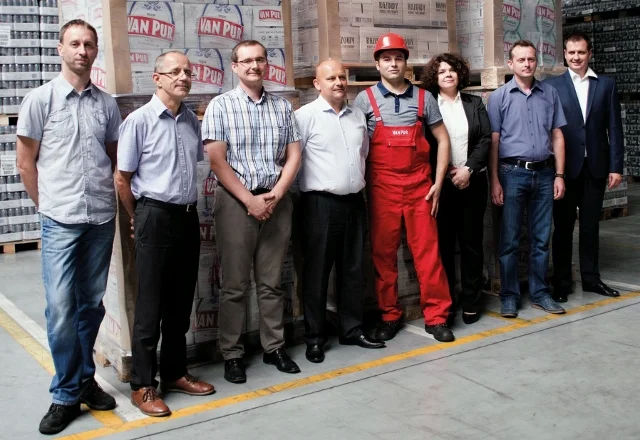
From left: Leszek Walawender, Wieslaw Kolodziej, Dariusz Szul, Wiktor Zieminski, Rafal Pudlo, Marzanna Walawender, Dariusz Cisek, Grzegorz Mazur
The Rakshaw plant’s warehouses are mostly of the block structure type, with homogeneous goods. Block storage capacity is not clear, because the warehouse uses different material carriers (types of pallets), in addition, there are restrictions on the distribution of materials related to the type of packaging (for example, the number of layers of cartons on a pallet varies depending on the assortment), the warehouse also supports kegs. A significant part of the warehouse (sections) is dedicated to retail chains (private label production). The warehouse also has separate storage areas for materials that are distributed in quantities smaller than a pallet, the so-called picking (in addition, the ends of production batches are stored there), and there are also designated cross-docking areas near the loading gates.
Terminals, Middleware, Interfaces
According to the initial concept, the activities carried out in the WM module are performed by operators through radio barcode reader terminals and labelers and scanning devices integrated with the SAP system on production lines. The developed solution is fully integrated with the SAP modules operating in Van Pur to optimize activities in WM between areas (the customization work mainly concerned the areas of production and sales and distribution, as well as the LE-TRA tool for transportation planning).
The solution optimizes operations inside the warehouse, thanks to the ability to aggregate orders based on relevant parameters, such as aggregation of warehouse collection orders based on material index and the ability to pick transport carriers for heterogeneous and homogeneous releases.Two types of EAN 13 and UCC/EAN 128 bar codes are used, logistic units (pallets) are labeled according to the GS1 standard (SSCC numbers).
Integrating the SAP ERP system with the Middleware application supporting label applicators and code readers required building two data exchange interfaces:
- from SAP (where the process of preparing data for labels is initiated) to Middleware wanders the database, containing appropriately structured data on assortment, production version, etc.);
- Middleware (where the label for printing is created) transmits information about the storage unit number (SSCC), lot number, material quantity, best-before date, etc. to SAP.
The process of transferring data from SAP to Middleware is initiated automatically each time production is started for a new assortment. The data sent from Middleware to SAP are verified by SAP on an ongoing basis and if any problems arise, the operators operating the production line are informed of the situation with an appropriate message.
The process of transferring data from SAP to Middleware is initiated automatically each time production is started for a new assortment. The data sent from Middleware to SAP are verified by SAP on an ongoing basis and if any problems arise, the operators operating the production line are informed of the situation with an appropriate message.
Basic WM processes
The following main groups of warehouse management processes and functions were implemented in the project:
- handling incoming deliveries,
- production adoption,
- handling outbound deliveries,
- management of intra-warehouse operations,
- Inventory (according to the SAP WM standard).
Acceptance of production
After double verification of the correctness of the data on the labels (scanning the data stored in the barcode), with which a pallet of material being taken off to the warehouse is covered, the interface between the application handling the labeling and SAP is triggered. All data is saved in a specially prepared table. The following data goes into the table: pallet number (SSCC) lot number, expiration date, production version, EAN of the material, material code, etc. All data are recorded with accuracy to the second (unambiguous identification of the time of transfer of the material to the receipt of the pallet into the finished goods warehouse).
Once the data is stored in the table by SAP, then a program is run in the background, which in the first step performs the production yield to the virtual warehouse, and in the second step the consumption of components used to produce the finished product located on the storage unit. This is followed by the physical retrieval of the pallet from the end of the production line by the forklift operator and the scanning of the pallet’s SSCC number in a terminal transaction specially prepared for the customer, which displays data about the pallet’s contents. After scanning the pallet’s SSCC number, the appropriate validation is triggered in the background, whether for a given pallet’s SSCC number in a special table there is an appropriate status for obtaining material for the virtual production depot. After a correct check, the material is reassigned between depots (virtual production depot and physical WM depot), resulting in the generation of a transfer order in the background with a specific storage location, which is displayed in the above-mentioned terminal transaction.
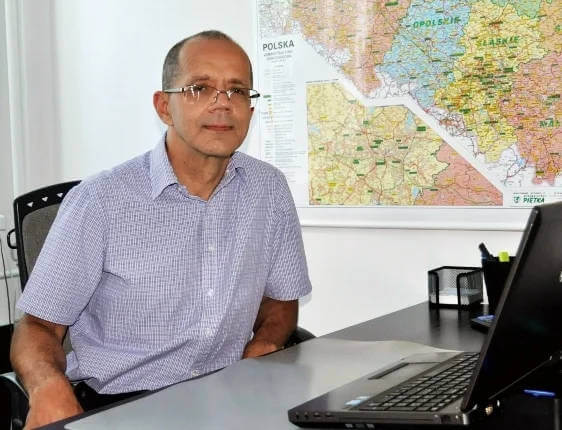
Wieslaw Kolodziej, Rakshaw Brewery Director, PP Project Team Manager, Van Pur
In line with market requirements
The implementation of the WMS has allowed us to meet market requirements for pallet marking and registration of merchandise turnover using the GS1 standard, and to improve the management of finished goods warehouses. The efficiency of warehouse employees has also increased, mainly due to the switch to using barcode readers to identify assortments, lots and expiration dates. There has been a reduction in the number of release errors, particularly in terms of FEFO queue maintenance and delivery rules to specific customers.
Wieslaw Kolodziej, Rakshaw Brewery Director, PP Project Team Manager, Van Pur
Before confirming the storage location, the warehouse operator has the option to change the storage location within the warehouse type. Once the placement of a storage unit in a location is confirmed, the material is available for further operations (sales, transfers to other facilities, etc.).
Incomplete pallets, so-called lot ends, are automatically distinguished and directed to a separate type of storage (they are not placed in blocks with full storage units), from which smaller quantities of materials are picked into “material mix" pallets.
Also, during the receipt of materials from production, so-called internal cross-docking is envisaged, i.e. putting materials down directly at loading zones in order to shorten the times for taking materials to the means of transport – transferring them to satellite warehouses or other plants. For the above-described process, the possibility of picking and transferring two pallets simultaneously (in one cycle) is envisaged due to the use of trucks with double forks (four, in the case of the DHP pallet).
Acceptance of goods from production is automatic, but some exceptions have been provided:
- No material yield for the virtual production warehouse – manual acceptance by the operator/administrator is possible,
- in the event of a failure of communication between Middleware – SAP, the data is queued, and when communication is restored, the data is retransmitted,
- Failure of the labeling machine – switching to manual scanning.
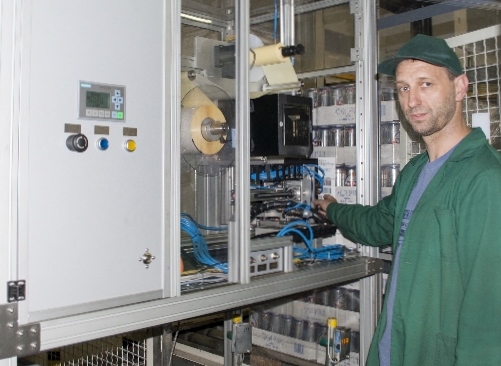
Leszek Walawender, Beer Bottling Plant Manager, Interfaces Project Team Leader, Middleware, Van Pur
First, automation
The introduction of automatic labeling of the finished product has eliminated the problem of manual application of pallet labels. Automatic confirmation of each pallet allows the current status of the finished product to be tracked in SAP in real time, the product is immediately available for sale. Automatic consumption of bottling materials is also a major improvement, making it easier to manage raw material stocks. And very important for us – fast tracking of batches of finished product, so-called traceability.
Leszek Walawender, Beer Bottling Plant Manager, Interfaces Project Team Leader, Middleware, Van Pur
Handling incoming deliveries
In 98%, external receipt is the receipt of materials from other plants or from satellite warehouses. In order to meet the customer’s requirements (automating the operation and reducing labor intensity and costs), a custom terminal transaction was created, through which the process of receiving materials into the warehouse is comprehensively handled (the same transaction is used in the process of receiving any returns from customers).
Receipt of material is carried out with reference to the incoming delivery and with the use of pallet labels, which comply with the GS1 SSCC standard. For this reason, a uniform SSCC label standard has been introduced at all plants.
The warehouse operator, after scanning the incoming delivery number (the barcode of the delivery number can be found on the incoming delivery advice printout), obtains all the information about the materials in the delivery. Then, after scanning the data from the SSCC label (data regarding the material being received, its EAN, lot, quantity of material on the pallet, expiration date, SSCC number), an order is created to move the material to a specific location in the warehouse, taking into account the appropriate strategy for placing the material in the warehouse. Once the placement of the storage unit in the location is confirmed and the incoming delivery is booked, the material is available for further operations.
In addition, SAP captures the SSCC number from the label and the storage unit in the warehouse is set up with this number. There is no need to generate new SSCC labels for storage units, which do not change their structure. Such labels continue to be used in the release process (customers require marking of transport units according to GS1 SSCC), which significantly reduces costs.
Lack of SSCC labels during reception is not a problem, the warehouse operator enters the necessary data manually in the terminal transaction, and then the system itself creates the corresponding SSCC labels (identical design as standard for all plants).
Also, cross-docking is taken into account when receiving from outside, which looks the same as for receiving from production. Also there is the possibility of receiving mix pallets (several materials, batches of material on one transport unit), where such a mix receipt is distinguished by the system and directed to a separate type of warehouse, from which smaller quantities of materials are picked for material mix pallets.
Full control of the warehouse
By automating the warehouses, we have greater control over capacity utilization and optimization of filling. Communication with warehouse employees has also been improved. The WMS has allowed us to remotely delegate tasks to terminals.
Andrew Golenia, Deputy Warehouse Manager, Project Manager, Van Pur
Handling outbound deliveries
Completion of releases is carried out according to the overarching FEFO (first expired, first out) strategy, which is standard in the food industry, where shelf life is decisive. However, this general rule has a number of exceptions, resulting, for example, from customer requirements, which forced the development of a custom mechanism that takes into account other warehouse release strategies in addition to FEFO.
The solution implements the handling of complex exceptions, covering the conditions of sale to a given customer. The system takes into account such parameters as, for example, the limitation of the quantity of goods with a certain expiration date for a given customer. The prepared solution makes it possible to handle all exceptions to the FEFO strategy occurring in Van Pur and still automatically prepare the delivery.
When proceeding to pick materials for release for a particular delivery, the operator sees on the terminal screen that the pick order includes only full pallets or mix or full and mix pallets. It is up to the operator to decide whether he will first prepare mix pallets and then pick full pallets, or vice versa. Of course, it is possible for two operators to perform these operations simultaneously in parallel. Completed MIX pallets (full pallets, too) are deposited at dedicated locations and then loaded onto the appropriate means of transport – during loading, operators are informed of the gate number where the means of transport is substituted for loading, as well as the name of the shipper and the registration number of the means of transport. However, for most cases, once the material is retrieved from the warehouse, the material is loaded directly onto the means of transport, bypassing the staging areas, and then the logic of loading full pallets first and then mix and ends is maintained.
After the entire delivery is collected and the operator closes the transfer orders, the system issues instructions for the next orders for the next delivery in the transport, if there is more than one. Such a solution helps maintain order in the staging area and works especially well when directly loading materials for transport with different unloading locations.
While Van Pur has long used the LE-TRA tool, SAP’s standard transportation solution, a number of improvements were made during the WM implementation, enabling, among other things, the advising and scheduling of transportation for time slots.
The situation is simple in the case where the entire transport is packed and sent to one unloading location. On the other hand, if with one transport the goods are delivered to several unloading places, automatic sorting of deliveries takes place. The system determines the order in which the goods are loaded at each unloading location, taking into account the logic of “last unloading – first loading on the means of transport."
The integration of LE-TRA with SAP WM made it possible to streamline the preparation of shipments to customers. It became possible to track loading stages and to print transport documents from under one button.
User-friendly system
The SAP WM solution for Van Pur has contributed to a significant improvement in the work of warehousemen. The system unambiguously indicates the target location where the material should be placed, so that the rotation requirements for individual materials are met. Equally unambiguous is the location from which the appropriate quantity and batch of material must be taken, with the applicable strategies.
Management (optimization) of warehousemen’s work is done with the help of an RF monitor.
Much easier and faster is the inventory process, which can be shortened by up to 70% compared to traditional methods by using terminals.
The entire solution has been designed to make as many processes as possible automatic, significantly reducing the time required to perform receiving, issuing or other warehouse movements. This philosophy – of automating and facilitating as much as possible – was also adopted in the design of the operator interfaces on mobile terminals.
The operator executing the order has on the display only the information necessary at the moment and buttons that call up further functions. Intuitive operation of the application significantly increases work comfort and reduces the time needed to learn how to use the terminal, which in turn facilitates the introduction of new employees. In addition, the terminals also display packing instructions, which is particularly useful when packing a pallet mix as well as material ends. The instructions include, for example, information about the customer’s preferences for how the material should be packed on the pallets.
Noteworthy, the mobile terminals run on the state-of-the-art web-based SAP ITS Mobile system.
Always up-to-date knowledge
Thanks to the WM system, our knowledge of the current inventory of finished goods and their distribution in the warehouse has increased, further supplemented by knowledge of production batches and expiration dates. SAP stock levels are updated after each pallet of beer taken over by the terminal from production or an incoming delivery and deployed at a given location in the warehouse. Labeling each pallet of goods coming off the production line with a logistics label allows the WM system to seamlessly track it from its descent from production and deployment in the warehouse, through intra-warehouse processes, to picking and loading the goods onto a transport unit.
Victor Zieminski, BOK Manager, Deputy Project Manager, Van Pur
Opening balance
Before the productive launch of the SAP WM solution, the warehouse had to be “stocked" in the WM system. Of course, all inventory existed in the SAP MM module. This operation proved to be quite a challenge, as the warehouse in Rakshawa alone holds about 19,000 pallets.
To cope with this task, it was decided (about three months before the productive launch of WM) that all pallets taken off production as well as pallets that arrived at Rakshava from other plants should be affixed with an SSCC label. Also for this purpose, a special terminal transaction was prepared with which barcode data was read from the SSCC label. After the data was acquired, the warehouse operator specified the pallet’s storage location in the warehouse, and then this data went into a specially developed table in SAP. In this way, the necessary information for stocking the warehouse in the WM system was acquired. When such a pallet (i.e., a specific SSCC) had to be released from the warehouse, there was a deletion of the data from the table, which was also done via a terminal transaction.
For security reasons and in order not to interfere with ongoing work in SAP, a copy of the entire productive system was made to the dedicated system, which was used to acquire data for conducting BO in WM. During the startup of the productive WM system, the data was copied onto the productive system, and then a dedicated program was run, which, based on the data in the table, made reassignments between the MM and WM depots, which further resulted in the generation and automatic confirmation of transfer orders at the corresponding storage locations.
This enabled the smooth stocking of WM’s warehouses, and naturally forced the parallel start of SSCC-standard labeling of pallets at all plants. In addition, a new logic was applied for the labeling of production batches of finished goods. This could not have been accomplished without the professional approach of Van Pur employees to the tasks set before them.
Business benefits
With the implementation of SAP WM and integration within SAP ERP, business benefits have emerged. The reorganized warehouse means efficient use of space and optimization of its stocking. This aspect in the case of Van Pur is all the more important because the company, preparing for the season, accumulates large stocks of finished goods.
24-hour production supported by radio terminals with SAP transactions ensures that goods will always reach the right place in the warehouse and the right assortment will be shipped to the customer. The ability to reassign priorities to individual warehouse employees allows flexible support of current priorities.
Working alone with SAP WM integrated with the transportation system, in addition to the benefits of better transportation planning and efficient shipment execution, supports the work of those employed in the warehouse and in the customer service office. Many activities previously performed manually and requiring organization outside the ERP system today support the system.
Cooperation: Piotr Górnicki
Hardware infrastructure for Van Pur
When designing the hardware infrastructure for Van Pur, HIT-Kody Kreskowe proposed logistics label applicators with Zebra ZE500 printing modules. This is Zebra’s latest system printing solution, which is distinguished by its robust design that simultaneously guarantees easy integration, fast replacement of consumables and trouble-free maintenance. The ZE500 ensures uninterrupted operation of automatic labeling systems. Middleware running on them is responsible, among other things, for printing labels with incremented barcodes, while keeping an eye on the correctness of SSCC numbers. When the labels are automatically applied to the pallets, the automatic scanning of the SSCC code is triggered, which triggers confirmation of the release transaction to the SAP system and the production is settled. An additional advantage of Van Pur’s custom-designed middleware is its ease of integration with the SAP system and multi-interface capability.
Warehousemen use Motorola MC9190 radio terminals with the LRI scanning module. This is the latest generation of equipment, the use of which guarantees access to state-of-the-art technology for omni-directional scanning of different types of barcodes, from short and long distances, as well as scanning of damaged or dirty codes.