


In a thriving organization, all its components are interconnected and must work efficiently. IT systems in a company “live", develop and grow with it, and this means that they must respond to the ever-increasing demands of the business. Over time, the number of processed data grows, more functionalities are implemented, new reports are configured. More and more users are working in parallel, the number of links and interfaces with other systems is increasing. This increases the demand for computing power and system availability.
Equally important is ensuring the security, integrity and availability of data. Under these terms fall, among others:
- A proven data backup system,
- powerful and scalable hardware,
- Operating system and database covered by the manufacturer’s support,
- Business applications covered by the manufacturer’s support.
Meeting the above requirements is one of the challenges facing IT architects in companies. Anticipating the requirements of the business, planning future solutions and carrying out changes to the architecture of IT systems accordingly require knowledge and experience from those responsible for developing and maintaining IT systems.
Time for change
SAP systems are among the important IT components at USP Health. The continuously developed solutions SAP ERP i SAP HR require that the infrastructure be maintained at a high level. This means keeping up with changes in the hardware market and meeting software manufacturers’ requirements for regular updates.
Organizations that base business operations on the agility of IT systems and infrastructure cannot afford aging hardware to raise the cost of maintaining systems and increase the likelihood of failure, and therefore raise data security risks. Other risks include limited ability to expand infrastructure and computing power, as well as to maintain compliance with the requirements of the latest versions of SAP databases and applications.
At USP Health, the moment has come to make the decision to replace equipment.
Replacing all hardware is a very demanding undertaking. It must be carefully planned to ensure the security and continuity of systems. Decisions made at this stage will affect future application development and IT maintenance costs.
USP Health has abandoned installations based on dedicated IBM AIX servers and operating systems in favor of virtualization based on VMware solutions. Such a change was decided by the benefits of virtualizing IT systems. The goals that were planned to be achieved were flexibility in administering the virtual environment, increased availability and scalability of systems, optimization of the use of the resources of the hardware used, and reduction of maintenance costs (TCO).

Mariusz Bałdyga, IT Systems Support and Development Manager, USP Health
Optimization, savings, security
The end of vendor support and the growing risk of failure were the direct reasons for the decision to migrate SAP systems. The decision to migrate IT resources to a virtual platform, based on x86 technology, VMware and Microsoft Windows Server, was preceded by an in-depth cost and functional analysis. The chosen solution allowed us to take advantage of the knowledge and experience gained from years of working with these technologies, as well as to optimize the use of the existing IT infrastructure. We also used the migration process to review and organize the systems landscape (abandonment of SAP BW, expansion of development and testing environments in the area of business process integration).
It is not insignificant that the security of the company’s operations has been increased through the application of a unified disaster recovery policy, in which SAP systems play a key role.
The migration of an IT system at a pharmaceutical company involves a parallel project to validate both the new environment and the migration work itself. As such, the project involved the entire company in addition to the IT team to ensure that the pharmaceutical industry’s highest quality standards were met.
Mariusz Bałdyga, IT Systems Support and Development Manager, USP Health
Migration systems
At the beginning of the migration project, the most important thing was to determine what the current SAP systems infrastructure was and which systems would be migrated, as this determined the scope of work, the assumptions for the migration execution methodology and the requirements for the new environment.
The architecture of the SAP systems at USP Health for which the environment change project was prepared were SAP ERP, SAP HR, SAP BW, SAP Business Connector and SAP Solution Manager. The SAP ERP, SAP HR and SAP BW systems were configured into a traditional landscape of three systems: development, test and production. SAP Solution Manager had a single installation, while SAP Business Connector was two systems: test and production. In addition, Employee and Manager Self-Service (ESS/MSS) functionality was implemented on the SAP HR system, based on the AS JAVA portal on SAP BW systems (dual-stack ABAP + JAVA).
The source systems ran on IBM AIX solutions and IBM DB2 database. On the target virtual platform, it was decided to use MS Windows operating system and IBM DB2 database. The change in architecture and operating system meant that SAP systems had to be migrated according to the SAP heterogeneous copy methodology.
Methodology and optimization
At USP Health , the migration of SAP ERP, HR and Solution Manager systems was planned according to SAP’s guidelines and procedures for a heterogeneous copy. One of the constraints that were taken into account was that there was a shortage of disk space on the source systems and it was not possible to provide sufficient space to perform data exports to physical disks.
For this reason, the migration of SAP systems made use of an advanced heterogeneous migration procedure, in which there is an export of data on the source system and a simultaneous import on the target system. Read data on the source system is immediately transferred over the network to the target system and imported into the database there. This method has eliminated the need to provide sizable disk space on the systems to store the data exports, while reducing the migration time of a single system.
In preparing the migration procedures, it was determined that SAP BW-based functionality would be extinguished. However, the system played an important role as an AS JAVA portal platform for employee and manager self-service solutions in SAP HR, which was used by USP Health employees. So a functional migration was proposed. The latest version of SAP NetWeaver Portal was implemented in the new environment, along with the installation of SAP MSS and ESS components for the HR system, in a landscape of three systems: development, test and production.
Subsequently, all ESS and MSS functionality was transferred from the old system, and during the migration of the SAP HR systems, connections were reconfigured so that the systems worked with the new SAP NetWeaver Portal. Thanks to this approach to functional migration, USP Health obtained a new version of the system SAP NetWeaver Portal, provided access to SAP HR functionality at an unchanged level, and at the same time avoided the need to migrate the no longer used SAP BW system.
The migration of SAP Business Connector systems also consisted of a functional migration. The latest version of the software was installed on the target systems, and then the system configuration and settings were transferred.
After the SAP Solution Manager system was migrated, the data and configurations of the old SAP systems were removed from the system, and the systems were reconnected and reconfigured after the migration to the VMware platform, adding new instances of SAP Enterprise Portal. The SAP Solution Manager system at USP Health also serves as the central system in the configuration of user and privilege management of SAP CUA systems. And this functionality was retained and reconfigured for SAP ERP and HR systems after the migration.
Secure schedule
The most important factor considered in planning the migration schedule was to ensure data security and eliminate potential errors, so that the migration of the production system would go smoothly and users would not be negatively affected by the change.
The migration of systems at USP Health was performed according to the following scenario.
A test migration of SAP ERP and SAP HR systems was carried out first. All systems in the landscape, that is, development, test and production systems, were migrated, and intensive testing of SAP systems and functionality began. At that time, two parallel landscapes of ERP and HR systems were in operation, and any changes made in the old SAP systems, which were still in production, were transferred and mapped onto the new systems.
At the same time, SAP Solution Manager was migrated, SAP NetWeaver Portal systems were installed and configured, and SAP Business Connector systems were migrated.
After the tests were completed, production migration dates were scheduled for SAP ERP and HR systems. Technically, the work consisted of removing the previously migrated production instance, and then performing the production system migration again according to the developed procedure and configuration steps. The old systems were stopped and users were switched to log on to the new environment.
This atypical approach to SAP system migration scheduling, as used at USP Health, allowed the entire systems landscape to be tested safely in time and an effective user switchover scenario to be developed during production migration. This, in turn, was a guarantee that nothing would surprise administrators, consultants, but most importantly end users.
Documents and procedures
At USP Health, validation activities and their documentation are standard procedure, including in IT projects. This is due to the specific nature of the pharmaceutical industry and related regulatory requirements. The Good Manufacturing Practice (GMP; Good Manufacturing Practices) standards used are mandatory in this industry, and regulated by numerous legal acts. They precisely define the requirements associated with the production and distribution of drugs. Quality control systems require that IT solutions not only comply with GMP, but also that this can be proven and documented at every step of each of the company’s processes.
The migration of SAP systems therefore had to be carried out not only in accordance with SAP’s methodology and best practices, but also meet all the requirements imposed by GMP standards. Following one of the basic principles of GMP: “what is not written, is never done," numerous documents were created during the work, which accurately and in detail reflect the entire course of work.
BCC (now All for One Poland) has been cooperating with companies in the pharmaceutical industry for years, carrying out numerous implementation, development and system migration projects. The experience of the consultants, who took part in similar SAP system migration projects implemented in accordance with GMP requirements, allowed the efficient and effective execution of the entire work at USP Zdrowie.
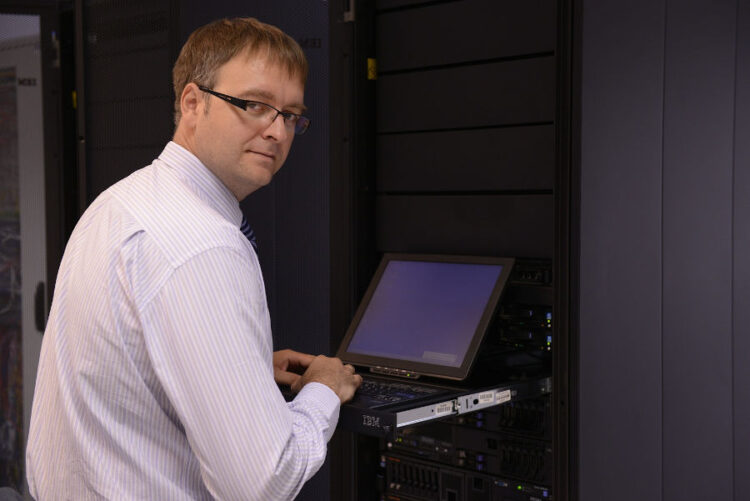
Michał Strzyżewski, IT Area Manager, All for One Poland
Virtualization – consistent architecture, freedom of IT disposition
A way out of hardware limitations is virtualization, which is widely used today. By virtualizing the architecture of servers, arrays and networks, we gain the freedom to run operating systems within a single architecture. We can assign the required amounts of processors, RAM or disk space to the created environment. If there is an increase in demand, each of these values can be adjusted to meet new needs. In most cases, we can increase the performance and size of virtual machines without the need to restart the machine.
Virtualization also provides opportunities for “mobility" of servers. If we use a solution with two data processing centers (CPDs), we can move running virtual machines between different, geographically distant locations in the so-called vMotion mode (borrowing from VMware technology).
BCC implements projects for consolidation and virtualization of IT environments based on solutions from the world’s leading providers of solutions of this type, including VMware, Microsoft (Hyper-V). In projects for clients, we also have at our disposal the competence and many years of experience in using virtualization both for our own needs and for the needs of our clients’ systems, which are hosted at All for One Data Centers.
Michał Strzyżewski, IT Area Manager, All for One Poland
Planning and management
The SAP systems migration project at USP Health required the involvement of a large number of people. On the one hand, it was USP Zdrowie employees responsible for maintaining the IT infrastructure, who were additionally responsible for designing and preparing the systems on the new VMware virtual platform and actively supported the entire migration and testing process. Next were BCC consultants responsible for data migration of ERP, HR and Solution Manager systems, implementation and configuration of SAP NetWeaver Portal, functional transfer of SAP ESS and MSS, and SAP Business Connector. They also supported functional testing and prepared fixes for reported problems on an ongoing basis. Also large was the team involved in functional testing. Managing such a large team required a great deal of flexibility and commitment from the project managers on both the USP Health and BCC sides.
At the end of December 2015, all work was completed and the last of the production systems was migrated and put to work for end users. The absence of errors related to the migration process is due to the well-designed schedule and adopted methodologies, but most importantly to the cooperation and commitment of those directly involved in the work and supporting the project.
The use of virtualization for SAP systems at USP Health has improved their performance and security, reduced maintenance costs and enabled flexible management of computing power. It also makes it possible to manage hardware infrastructure more efficiently and counteract the aging of the hardware platform. This in turn means more efficient and effective operations on the business side.