


What's next for SAP BW?
Modernizing the SAP data warehouse or other options?
How and when should you migrate from your existing SAP BW environment to new solutions? Should you opt for a greenfield implementation SAP Business Data Cloud? Or perhaps the BW Private Cloud Edition in SAP BDC? Or should you migrate to SAP BW/4HANA? In practice, the decision regarding the future of SAP BW involves maintenance costs, responsibility for data logic, reporting quality, readiness for new technologies, as well as whether the organization wants to extend the life of its current data warehouse or use this opportunity to undertake a broader modernization of its analytics capabilities.
How and when should you migrate from your existing SAP BW environment to new solutions? Should you opt for a greenfield implementation SAP Business Data Cloud? Or perhaps the BW Private Cloud Edition in SAP BDC? Or should you migrate to SAP BW/4HANA? In practice, the decision regarding the future of SAP BW involves maintenance costs, responsibility for data logic, reporting quality, readiness for new technologies, as well as whether the organization wants to extend the life of its current data warehouse or use this opportunity to undertake a broader modernization of its analytics capabilities.
A functioning data warehouse consists of proven data models, critical reports, KPI definitions, and business knowledge built up over the years. But it also includes elements that are worth simplifying or replacing with a new approach. That’s why the most important question is: what should we take with us from the current environment?
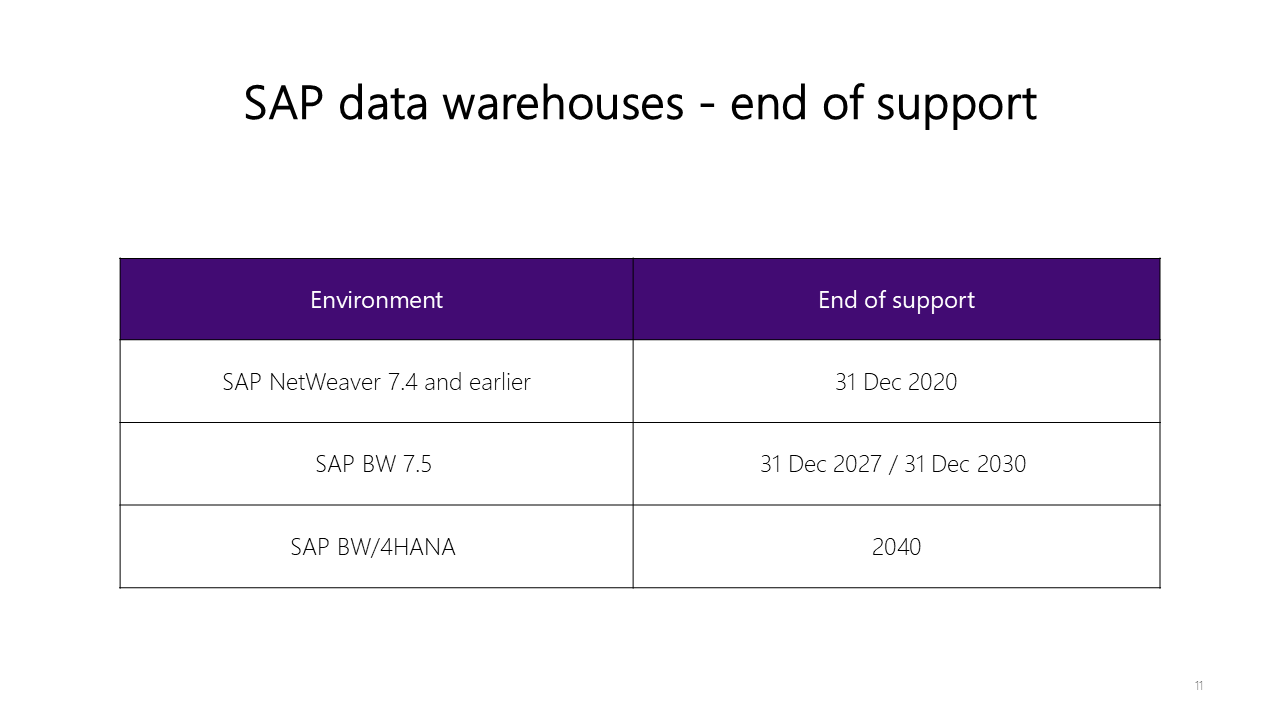
From a timeline perspective, the situation is already quite clear. Older versions of SAP BW based on SAP NetWeaver 7.4 and earlier reached the end of mainstream maintenance on December 31, 2020. Companies using SAP BW 7.5 have more time, but they also face a real deadline for deciding what to do next: mainstream maintenance for their version lasts until the end of 2027, and optional extended maintenance until the end of 2030. SAP BW/4HANA, on the other hand, is expected to remain supported at least until 2040.
At the same time, it would be a mistake to view this issue solely through the lens of maintenance expiration dates. In many organizations, the question “What’s next for SAP BW?” is resurfacing today because the costs of maintaining the current system are rising, users expect a simpler interface, and the business needs a broader range of reporting capabilities and faster access to data. Companies are realigning their strategies around SAP S/4HANA, considering cloud models, and increasingly viewing data as the foundation of modern analytics, planning, and AI.
That is why the question of SAP BW’s future today rarely concerns only vendor support. Much more often, it also encompasses the scope of reporting, the costs involved, the level of risk, responsibility for data logic, and the role data is expected to play in the company over the coming years. Two organizations may have the same system version and the same maintenance schedule, yet still reach completely different conclusions regarding the direction of their data warehouse’s development.
At this point, it is worth distinguishing between three initial situations.
- The first group consists of companies using older versions of SAP BW, namely 7.4 and earlier. For them, the question is no longer “whether to do something,” but rather “how to plan the way forward quickly and sensibly.”
- The second group consists of companies using SAP BW 7.5. This is where the question most often arises: Is the goal to gain additional time, simplify the system, migrate to SAP BW/4HANA, or prepare for a broader modernization using SAP Datasphere and SAP BDC?
- The third group consists of companies using SAP BW/4HANA. In their case, the time pressure is less, and the discussion often centers on whether the current system should remain a stable core for years to come or serve as a stepping stone toward further modernization.
In practice, there is no single right answer for everyone. Most often, there are three reasonable options to choose from: upgrading the existing BW to the BW Private Cloud Edition within SAP BDC, a greenfield approach in SAP Business Data Cloud (SAP BDC), and migrating to SAP BW/4HANA.
New Course: SAP Datasphere and SAP Business Data Cloud
SAP Datasphere, part of SAP Business Data Cloud, is a next-generation cloud-based data warehouse. SAP BDC itself is a broader concept—it is a fully managed Software as a Service (SaaS) environment that integrates SAP and external data, supports analytics, and paves the way for new AI-based scenarios.
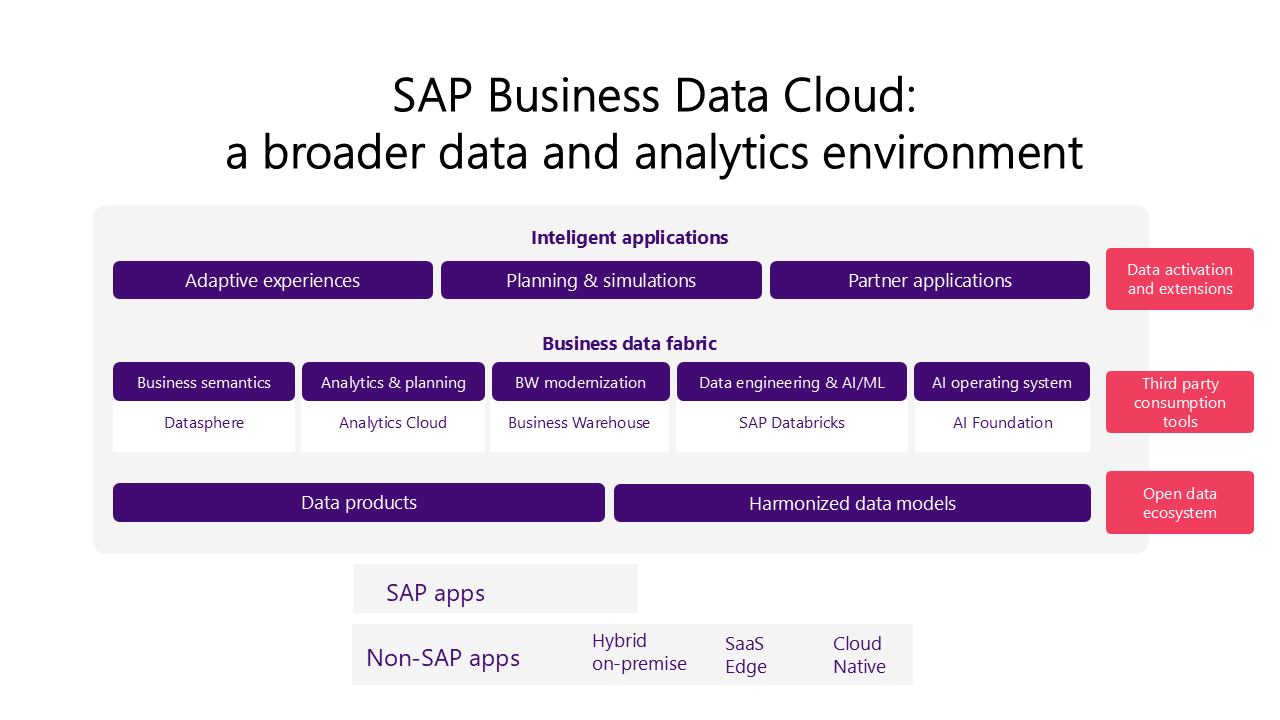
This is an important distinction. SAP Datasphere is primarily responsible for data integration, cataloging, semantic modeling, federation, and virtualization. SAP BDC covers more: not just the data layer, but the entire modern data workflow—from analytics and planning through data products to ready-made business scenarios and AI-based applications. This is precisely why, for many organizations, BDC is becoming not just another tool, but a viable candidate for their target data environment. In this context, data products play a key role—these are structured, ready-to-use data resources that retain their business context and are prepared so they can be securely shared and further utilized in analytics and AI.
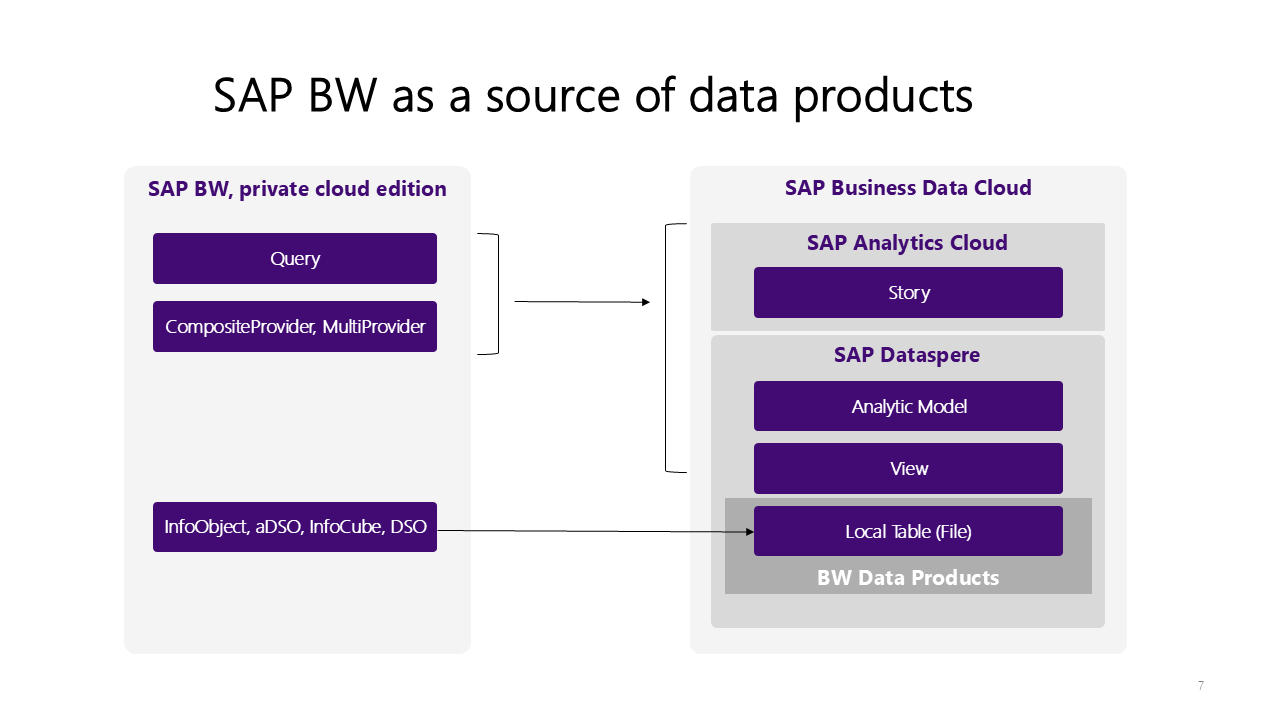
SAP Analytics Cloud, in turn, serves as a tool within the SAP BDC architecture for creating interactive dashboards, planning, and forecasting. With this tool, end users analyze data and draw conclusions based on it, including through the use of AI tools.
Another strength of BDC is its intelligent applications—ready-to-use, fully managed AI-based applications built on certified data products. SAP describes them as applications that understand the business context, use predefined metrics, AI models, and planning elements, and are designed to translate data into decisions and actions more quickly. For a company, this means that not everything has to be built from scratch: some scenarios can be deployed as ready-made components embedded in specific business areas.
An additional advantage is SAP Databricks, which is natively available in SAP BDC. It is a built-in environment for data engineering, machine learning, and more advanced data processing, with access to SAP and third-party data and support for zero-copy Delta Sharing. This is particularly important for organizations that want not only to generate reports but also to develop more advanced analytics and AI scenarios without having to build a separate, distributed architecture from scratch.
Another important concept in this model is BW Private Cloud Edition (BW PCE), or BW in a private cloud. This serves as the starting point for the first modernization path, in which SAP BDC data products can be generated based on SAP BW objects; these can then be further modeled in SAP Datasphere, analyzed using AI in SAP Databricks, or visualized in SAP Analytics Cloud.
One system, three paths
Choosing the right path from the existing BW system to new solutions is a complex issue. Factors to consider include the scope of reporting, the scale of changes, maintenance and migration costs, user skills, business readiness, and the importance of preserving the current data logic. Below, we present three possible scenarios.
BW Private Cloud Edition in SAP BDC (BW PCE)
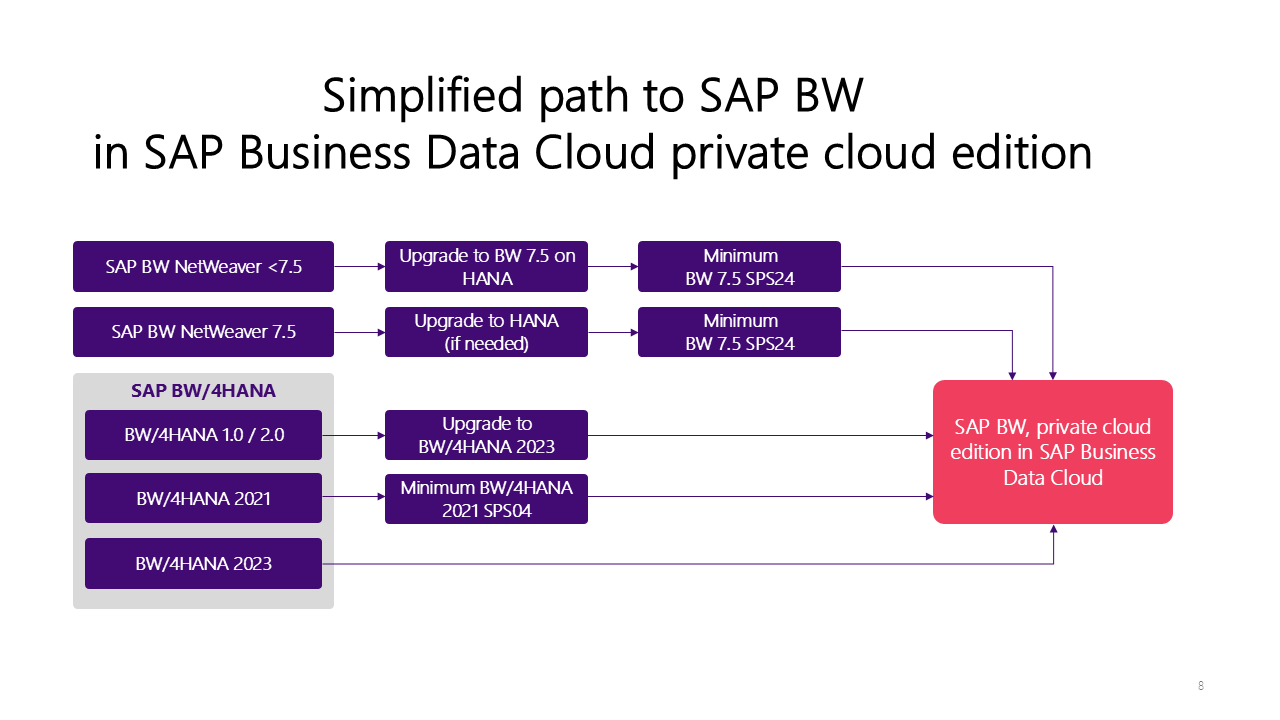
One of the most practical approaches today is to migrate an existing SAP BW 7.5 or SAP BW/4HANA environment to the private cloud edition in SAP BDC. In this model, the environment can be migrated “as is,” without immediately having to rebuild the entire core. This solution ensures continuity, relieves the company of the burden of managing infrastructure, extends the support period (until 2030 for SAP BW 7.5), and paves the way for new tools within SAP BDC and better integration with new systems.
However, the value of this path doesn’t end there. Data from BW can then be used in SAP Datasphere, reported on and visualized in SAP Analytics Cloud, made available as data products, and used in new AI scenarios. In practice, this is how the “lift, shift, innovate” logic should be understood within this path: first, you migrate the environment (lift), then you make the data available and use it in other SAP BDC tools (shift), and only then do you build new models and reimplement the current solution using new technology (innovate). In this way, by fully leveraging existing data processing in SAP BW, you can take advantage of new technologies, AI, and a user-friendly interface.
The diagram below shows the options for migrating from SAP BW to SAP BW PCE, depending on the version of the current system.
This solution is primarily designed for large-scale SAP BW and SAP BW/4HANA data warehouses, where simplifying and reimplementing the current reporting system can be time-consuming and complex. At the same time, this approach allows you to take full advantage of the data processed in the current system using the tools available in SAP BDC.
SAP BDC Greenfield
The second path is the greenfield approach in SAP BDC. This makes sense primarily for smaller SAP BW data warehouses, for which reorganizing, simplifying, and reimplementing the current solution is neither too time-consuming nor too risky from a business perspective. In this scenario, the organization does not migrate the old system in its entirety but instead builds a new environment based on the target architecture, utilizing intelligent applications, the SAP Datasphere data warehouse, or AI in SAP Databricks.
With this approach, we can achieve a simpler data model, more quickly shed historical baggage, and better adapt to new needs. However, it requires greater organizational readiness, a thorough understanding of reporting needs, and a careful assessment of whether it is actually worthwhile to build a new environment rather than protect existing investments.
Migration to SAP BW/4HANA
The third path is a migration to SAP BW/4HANA. For many organizations, this may still be a very sensible option, especially when a company wants to maintain a classic SAP data warehouse, simplify its core systems, and at the same time avoid embarking on a broader cloud transformation right away. This approach offers a longer maintenance horizon, lower architectural risk, and better integration with newer SAP systems.
However, this is not a one-size-fits-all decision. If a company’s primary goal is broader data modernization, greater openness to non-SAP sources, or new AI and data product scenarios, the path to BW/4HANA alone may be too conservative. On the other hand, if the organization is not ready to transition to the target infrastructure (SAP BDC), SAP BW/4HANA can certainly serve as a transitional step.
Ownership and Costs
In many companies, the question “What’s next for BW?” eventually turns out to be less of a technological issue and more of an ownership issue. Who owns the definitions of KPIs (Key Performance Indicators)? Who decides which reports are still critical and which are merely historical? Who is responsible for the quality and consistency of the data logic? Without answers to these questions, even a good architecture quickly begins to take on a life of its own—one that’s largely out of control.
The same applies to costs. A fair comparison of options should include not only the license or subscription, but also infrastructure or hosting, the migration or conversion project, the reorganization of reports and models, testing, organizational change, ongoing maintenance costs, and the cost of inaction. The cheapest license or subscription does not necessarily mean the cheapest decision.
What to keep, what to simplify, what to develop
This is one of the most important steps in the entire decision-making process. After all, the future of SAP BW isn’t just about choosing a new name for the technology. First, you need to answer three very practical questions.
- What’s worth keeping. This refers to critical business logic, reports that are actually used, and areas that truly drive management decisions—such as controlling, finance, sales, and planning. It’s not what’s been around for a long time that’s worth keeping, but what continues to create value;
- What should be simplified. This usually includes obsolete reports, historical dependencies, duplicate logic, and objects that are kept solely because no one has decided for a long time whether they are still needed;
- What to develop next. This is where the discussion begins about new needs that should no longer be forced into the traditional BW model—such as data from outside SAP, data products, new models of information consumption, or scenarios involving artificial intelligence.
In practice, a good first step is often a systematic assessment of the current business intelligence environment. This allows you to determine which areas are still actively used, where it’s worth simplifying the logic and reporting, and where the scope for further modernization actually begins. This makes it easier to distinguish between what still creates value and what has become more of a historical burden.
A mature decision, therefore, is not about keeping everything or replacing everything. It’s about separating the assets from the burdens and not trying to carry everything forward into the future in the same form.
Where should I start?
First, it’s important to determine whether the main issue today concerns maintenance, reporting, ownership, or the broader data architecture. Then, assess what is actually being used and is valuable in the current environment. Next, separate what is worth keeping from what should be simplified and what should be developed according to the new logic.
Because the question “What’s next for SAP BW?” isn’t really a question about technology. It’s a question of whether the current data layer still meets the organization’s needs now and in the future. And if not—what should be retained, what should be simplified, and what should be expanded so that the next step is truly sensible.
If the future of SAP BW is currently a topic of discussion at your organization, please feel free to contact us. We can help you sort through the possible scenarios and choose the strategy that best fits your business needs, data, and architecture.