

The decision to establish a Shared Service Center was made at Animex in 2009. What was the reason behind it?
Andrzej Abramovich: In fact, there were many reasons, and the decision was a process rather than an event. The motivation for this decision should be sought primarily in the growing expectations of both the owners and customers of the company. The owner expects an increase in the profitability of the business, while customers expect increasingly better products at competitive prices. Animex, like many other companies, in order to meet the growing market expectations, optimizes its processes in various areas of its business. Until 2009, by virtue of its business profile, Animex focused primarily on optimizing production and production-related processes . The decision to establish a CUW initiated actions to streamline the company’s operations in the areas of the so-called back office. It was the need to improve the organization in this “forgotten" area of many production companies that contributed to the decision to create a CUW serving all Animex Group plants.
The creation of the CUW was also strongly influenced by the earlier decision to implement the SAP ERP system system in Animex’s headquarters and production plants. Supported by BCC (currently All for One Poland), the implementation of a uniform SAP model throughout the group required many organizational changes at each plant. Organizational changes were also necessary in the financial divisions of all organizational units, as a consequence of which Animex’s management decided that it would be much more efficient to handle many financial processes of all plants in one place.
What services were considered for implementation under the CUW?
A.A.: In the first version, there were to be only classic accounting services, such as posting purchase invoices and bank statements, keeping records of the general ledger and auxiliary ledgers (fixed assets, accounts payable and others), and preparing mandatory reports and tax returns. As the situation developed, expectations for the scope of services provided by CUW began to increase, and now the scope of services we provide also includes debt collection, credit control, billing and controlling reporting, electronic and paper archiving of invoices and contracts, management of the SAP master database, and coordination of EDI cooperation with customers. In the near future, we plan to further increase the scope of services provided by the Center.
The creation of the CUW involves major organizational changes for the company. A new unit is being created to take over important aspects of the company’s operations. How did you prepare for this?
A.A.: The analysis of the actual state of affairs and the proper identification of the necessary organizational changes related to the migration of processes to the Shared Services Center, previously handled by production plants, are key activities of the preparatory stage in the process of establishing our CUW.
We started by identifying all the processes that were handled in the financial divisions of Animex Group plants. We then properly documented the course of each process, isolating its various stages and the activities performed. In the next phase, we decided which processes and to what extent we would handle in the CUW. A very important element was to establish the links between the processes being taken over to the CUW and the processes that were ultimately to be handled at the plants. It is these linkages that determined most of the organizational changes we had to make at the plants in connection with the establishment of the Shared Services Center.
It was also important to determine the labor intensity of activities performed as part of a given process. This was a very difficult part of the analysis, especially since we were able to estimate the labor intensity of individual activities carried out using completely different IT tools and systems than those we intended to use at CUW. In turn, proper estimation of the labor intensity of individual activities in the CUW was necessary for optimal design of the organizational structure, determination of the scopes of responsibilities of individual positions, and estimation of the appropriate number of people employed in a given position.
The creation of CUW itself, from the perspective of Animex’s experience, would not have been such a difficult task if its implementation had not coincided with the implementation of six integrated SAP ERP modules, as well as SAP Workflow and an external workflow system integrated with SAP ERP. We made the risky decision to launch CUW and start SAP ERP at the same time, because such a solution was optimal in terms of cost, as well as the time required to implement the changes. Good planning and coordination of activities allowed us to master many of the organizational difficulties involved in implementing such a difficult project.

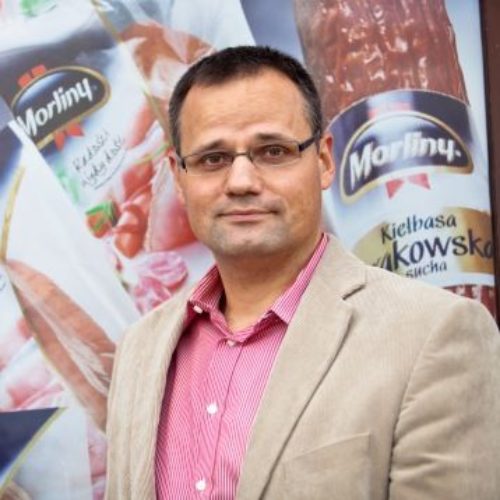
Andrzej Abramowicz, Managing Director of the Shared Services Center, Animex
How has this process affected your dealings with contractors and customers on the organizational and commercial side?
A.A.: I can say with certainty that the launch of CUW does not significantly affect the company’s contacts with customers or suppliers. The proper identification of activities related to customer service and cooperation with suppliers made it possible to properly carry out and communicate the changes, which mostly involved changing the places of contact with Animex.
The implementation of SAP ERP at Animex plants had a much greater impact on cooperation with our business partners, e.g. the posting of purchase invoices in reference to orders issued in the SAP system requires suppliers to include our order number on invoices documenting deliveries made under a given order. Of course, suppliers were informed of this change in due course, but full implementation required time and consistent efforts.
The implementation of SAP ERP at a particular Animex plant also required a one-time suspension of sales at the plant in question for a period of 2-3 days, which also briefly affected cooperation with our customers, who had to stock up on our products in advance to ensure their continuous availability on store shelves.
What is the scale of the CUW – how many employees, how many accounting documents per year, how many establishments are served?
A.A.: Currently, we provide the full range of available CUW services to four branches located in Morliny, Ilawa and Elk. In the near future, we plan to take over the handling of financial and accounting processes from two more plants. Currently, the CUW employs 54 people, and ultimately, i.e. when we provide a full range of services for all 11 Animex branches, we will employ about 70 people. We estimate that at that time we will be posting more than 130,000 purchase invoices annually, which will be handled by a 24-person team.
What benefits has the Animex Group gained from the creation of the CUW?
A.A.: The creation of the CUW, or rather the takeover of the handling of financial and accounting processes from Animex plants to the CUW, “relieves" the employees of production plants from activities not related to the basic activity of the plants, thus creating the possibility of concentrating the plants on Animex’s core business, i.e. the effective production of high-quality meat products.
Transferring the handling of many processes from more than a dozen plants to a single business unit has created excellent conditions for the optimization of these processes, primarily due to the increase in the scale of activities carried out, the possibility of using efficient solutions, dedicated to mass activities. In addition, the registration of a lot of financial information in one place causes, among other things, that all plant costs are subject to identical classification rules. Standardized data processing operations and the preparation of business reports according to identical rules, ensures better comparability of data, and thus allows a more objective assessment of the effectiveness of the operation of individual business units.
Not negligible is also the significantly lower cost of handling financial and accounting processes in a single business unit, compared to the cost of handling the same processes dispersed over a dozen plants. The number of employees involved in accounting work will be reduced by more than 40%. In addition to obtaining the so-called “economies of scale", it is also beneficial that we need expertise in accounting, taxes or certain areas of law in one location, which is more cost-effective and allows us to build better competencies of such departments.
In addition, the massification and standardization of many processes has made it possible to divide the competencies of individual financial and accounting positions more organizationally secure, which allows for effective risk management, elimination of inefficient operations or possible fraud.
What value does SAP bring to the daily work of the CUW, what improvements?
A.A.: Every modern Shared Service Center, in order to operate, must use IT tools to support the implementation of basic activities, such as invoice posting , reporting, etc. Fortunately, while creating the Shared Service Center, at the same time we were implementing the SAP ERP system, covering not only financial and accounting modules, but also areas related to logistics. This allowed us to configure the system in such a way that it not only allowed us to register individual documents in the system, but did so in a consistent and transparent manner in a multi-company structure .
An additional benefit is the use, with many processes, of EDI electronic data processing mechanisms that automatically reflect certain business processes. An excellent example of this would be Intracompany processes or processes related to sales . In these processes, orders and invoices are sent electronically, which significantly reduces the time required for processing, and the role of the CUW at this point is mainly to check the correctness of the postings and prepare the relevant reports. The ERP system has facilitated month-end closing and preparation of consolidated reports based on actual data. Not insignificant in a distributed structure is the ability to use Workflow tools (both in and out of SAP), allowing acceptance of invoice documents without physically sending them, which affects the time from recording to paying the supplier.
At CUW, you use the capabilities of SAP Workflow. In what areas?
A.A.: We use SAP Workflow in the processes of setting up and modifying the data of basic index files, supplier and customer files, and order approval processes.
How do you assess the benefits in implementing SAP Workflow?
A.A.: The process of setting up a new material index in SAP requires filling in a number of insights of the basic data of a given index. The individual insights are completed by employees with the appropriate knowledge and competence. They work at different locations in the organization. SAP Workflow enables tasks to be completed in the right order, directing the task to the appropriate participant, depending on the stage of the process. In general, in all processes supported by SAP Workflow, the system enforces an automatic and transparent flow of tasks, documents or information in the right order, at the right time, in the required form, to the right place and to the right person in the organization. The advantage is also that for certain processes we have a single channel of communication and full documentation of the process. These are enough advantages of this SAP functionality that convinced us to implement it.
Interviewed: Monika Kanigowska