


Given the variety of existing systems, including SAP ECC or external non-SAP transactional systems, among others, a decision was made at the Polish Committee for Standardization to integrate data from all transactional systems. After performing an in-depth analysis, the choice fell on the data warehouse SAP BW (SAP Business Warehouse 7.5). The system was intended not only to integrate the reporting environment at PKN, but also to properly aggregate data in information cubes, allowing business people to quickly access historical results. The implementation of SAP BW was entrusted to the experts of SNP Poland (currently All for One Poland), who began work in March 2018.
Before implementation
So far, during the reporting process, the organization has used native transactions in the system SAP ECC, as well as from the Crystal Reports tool, connected directly to external non-SAP transaction systems. However, such a solution had a number of drawbacks – such as the need to store Crystal Reports files on users’ workstations and the difficulty of editing reports. A business user could not dig into the data or run the analysis process on his own to find the required answer to a business question.
Web platform
The main requirements placed on the project to implement the SAP BW system at the Polish Committee for Standardization were the ability to use reports using a web-based platform and real-time access to data from external transactional systems other than SAP.
The first postulate was implemented using the SAP Portal platform, where all reports generated using the standard BEx Web Application Designer tool were published.
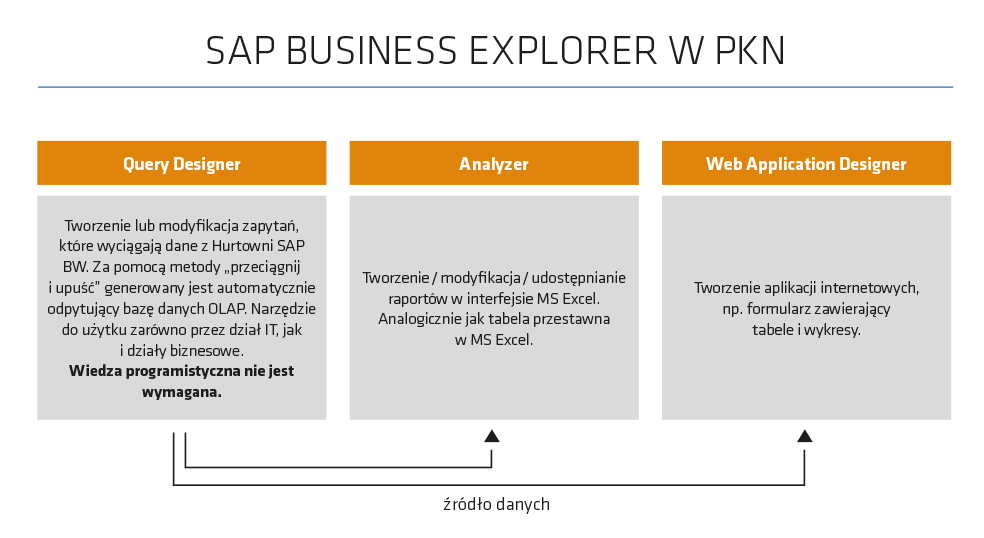
Access to real-time data was achieved by implementing virtual cubes for data from external transactional systems. This type of cube differs from a standard one in that it does not physically store data in the SAP BW system, but transfers data from the source system via RAM and makes it available to reporting applications. It is worth mentioning here that the standard reporting tools offered by SAP in the package with the SAP BW data warehouse system have been used in full. These tools, which come from the SAP Business Explorer range, include: BEx Query Designer, BEx Analyzer, BEx Web Application Designer.
- BEx Query Designer is a tool for creating so-called queries, i.e. queries to an OLAP-type database. This querying is done using a special database language MDX (MultiDimensional Expressions), which is an extension of the standard SQL language. SAP has taken special care of business users, as no knowledge of code is required to query the database.
- BEx Analyzer is an overlay for the popular Microsoft Excel spreadsheet.
- BEx Web Application Designer is a tool for creating web applications. It works on a drag-and-drop basis, so that objects created in HTML do not require technical knowledge of it.
The following graphic shows the location of the described tools. You can see that the data obtained with Query Designer feeds the front-end tools, i.e. Analyzer and Web Application Designer.
150 reports…
After the pre-implementation analysis phase and the structuring of PKN requirements, the implementation phase began, resulting in 150 reports. The data comes from external transactional systems (including a labor management system, a system supporting an online store or a system for creating new products) and from the SD, FI, HR modules of the SAP ECC system. In addition to the aforementioned virtual cubes for physical data storage, DataStore objects were used, storing data at the document level (e.g., invoice level), as well as information cubes, responsible for aggregating sales data.
120 report recipients…
In the final phase of implementation, all required business users were trained to use the system, making it possible to share reports with more than 120 end users. SAP Portal made it possible to automatically distribute reports to users’ mailboxes or periodically send reports for printing. It is worth mentioning that report permissions have been implemented at an exceptionally extensive level, so that within a single report the user sees only the data relevant to him or her.
Conducting training has largely enabled the Polish Committee for Standardization to manage system architecture on its own, and business staff to create simple reports.

Teresa Sosnowska, Deputy President of PKN for Standardization, Polish Committee for Standardization
New reporting system
PKN’s Standardization Division is one of the main recipients of reports in SAP Portal. Although preparing the data for the reports was a difficult and labor-intensive process, very soon we began to feel the concrete benefits resulting primarily from the availability of the reports to more employees, especially to the employees of the Sectors of the Standardization Division. This streamlined the work of the Sectors’ managers, who were the only ones with the authority to generate so-called Crystal Reports. Reducing the technical tasks performed by managers allows them to focus on strictly substantive work.
The reports have greatly facilitated the organization of our work and accelerated the acquisition of needed information. At the same time, the involvement of the division’s employees in the process of preparing them has encouraged the development of advanced reports that allow us to obtain more information of various types on the business processes implemented or monitored in the division. The new reporting system significantly supports the management of data recorded in the PKN system, such as sorting data for archiving, verifying its integrity or obtaining data for PKN annual reports.
Teresa Sosnowska, Deputy President of PKN for Standardization, Polish Committee for Standardization
Benefits
The production launch of the new reporting platform took place in June 2018, while users’ satisfaction with the new system meant that it was constantly being improved, and the final work was completed in March 2019. Thanks to the implementation of SAP Business Warehouse, employees of the Polish Committee for Standardization can take full advantage of the web-based platform bringing together all operational and strategic reports. The time previously used to find reports on local workstations or extract the required business information from reports can now be allocated to ongoing standardization work.

Beata Liszkiewicz, Head of Department, Information Technology – Software Exploitation Department, Polish Committee for Standardization
New reports, clear entitlements
On the basis of the business process linkage analysis carried out earlier, we decided that the most important thing was to determine the requirements for the new environment and choose the implementation methodology for the SAP BW system. The implementation involved both SAP BW systems and the SAP Portal system, used as a user interface.
The systems architecture is a two-system landscape: development/testing systems and a production system. SAP BW is based on the AS ABAP application platform, and for end-user access and data presentation, it uses SAP Portal on the AS JAVA application platform. Therefore, SAP Portal systems in the latest version of SAP NetWeaver 7.5 were installed, and all BW portal functionalities were implemented on these systems.
SNP Poland (now All for One Poland) provided substantive support from SAP BW and SAP Basis consultants. During the implementation, it provided training for administrators on Query Designer and WEB Application Designer tools, which allowed them to quickly apply their knowledge to prepare new reports and develop a clear system of permissions and data distribution. Thanks to the implemented permission policy, users using the same report see only the data they need for their tasks.
Beata Liszkiewicz, Head of Department, Information Technology – Software Exploitation Department, Polish Committee for Standardization
Marcin Rębelski, Project Manager, Polish Committee for Standardization

Marcin Rębelski, Project Manager, Polish Committee for Standardization
DATA DRIVEN COMPANY
The growth of companies in the market, combined with the constant development of technology, is forcing organizations to continuously invest in IT areas. Emerging trends, such as Big Data, are posing new challenges to managers. The functioning of companies is heavily dependent on the accuracy of decisions made by executives. Decision-makers can more accurately determine operational activities and thus bring profit to the organization by having access to a variety of data sources.
Data collection and what’s next?
Often, in addition to a modular ERP system, companies have a separate system for such things as creating new products, managing an online store or monitoring the status of production machinery. Integrating all these data sources becomes very time-consuming and difficult. The solution is Data Warehouse systems. Their main task is to collect data scattered in different source systems, which are used to generate strategic reports in enterprises.
Source of competitive advantage
“Data-driven company," when translated: “data-driven company," is a concept that has been associated with a very strong economic trend in recent years. It is closely related to gaining a competitive advantage in the market. To be able to define it well, it is necessary to refer to another key term, “Business Intelligence." The term “Business Intelligence" emerged not so long ago, and it owes its fame primarily to the fact that it directly connects the world of information systems with the world of business. The scientific areas that make up Business Intelligence are statistics, econometrics, operations research, artificial intelligence and database technologies. At a certain stage in the operation of an enterprise, the influx of data necessary to create various types of analysis and, consequently, to make key decisions, proves to be too much to handle. Phenomena related to this are common. They are the “Knowledge Gap" and the “Execution Gap." The first concept is the difference between the amount of incoming data and the actual amount of data that has been analyzed. The second is the difference between the amount of information provided from the data and the final actions, decisions made based on the data.
Due to the constant influx of data, often streaming, these differences are steadily increasing over time. Nowadays, the main analytical tool of a sizable group of managers is still Microsoft Excel. However, it is not adequately equipped to analyze large amounts of data, primarily because of the limitation of 1 million rows. Microsoft Excel also does not provide the ability to perform adequate data processing for analytics.
Due to the time-consuming nature of collecting data from transactional systems and then subjecting it to the necessary analysis, a separate analytical system is required, responsible for collecting the data and reading the results in the form of multidimensional queries. Such an analytical system is based on a Data Warehouse. Unlike a transactional system, which is responsible for operational data collection, an analytical system is geared toward long-term collection and aggregation of data.
The data warehouse described in this way forms the background – the back-end – of the concept of Business Intelligence. The surface layer of Business Intelligence is all the tools that present the results of created queries, ranging from simple tools that generate a simple static report containing aggregated results, through interactive reports that enable the so-called “drill down" procedure, i.e. digging into the data to find answers to key questions, to extensive data visualizations in the form of management cockpits, created “on-demand" (ad-hoc), or various types of business applications such as enterprise performance planning. The key task posed to Business Intelligence, then, is to deliver the right management information to the right people at the right time and in the right format. Making business decisions based on meticulously selected data is the key to gaining an advantage over the ever-evolving competition. This advantage is no longer just related to the price battle for customers, but primarily to improving competitiveness by responding quickly to changes in the environment and implementing the right decisions at the right time.
The broad realm of Business Intelligence allows you to attract new customers, increase sales and profits without price interference. In business, easy and timely access to personalized, intuitive information is essential for decision makers on many key issues. Managers today don’t need static KPI (Key Performance Indicator) reports providing the answer to the question “what happened?", but need dynamic, interactive management cockpits answering the question “why did it happen?". Quickly finding the cause of a company’s dysfunction makes it possible, in most cases, to save the organization from declining revenues.