


Glass from Krosno is valued for its good quality and interesting design at an affordable price. The brand’s signature products adorn very exclusive tables around the world. Krosno Glassworks, although currently in bankruptcy, is undergoing a restructuring process. Under the watchful eye of the trustee, the company is going out on a limb: financial condition is good, production is going full steam ahead, and goods are being shipped to all continents. A search for a strategic investor is currently underway.
Since 2008, the company has been using the system SAP ERP in the following areas: finance, controlling, materials management, production planning and sales and distribution. In 2012, the decision was made to add warehouse management functionality (SAP WM) to this integrated system. The implementation of the warehouse system is also one of the elements of the recovery program. Full control of the organization’s operations is not possible without rational and controlled inventory management. The immediate impetus for the project was the launch of the company’s new product warehouse, located in Podgrodzie near the A4 highway.
The new warehouse – a racked, high-bay warehouse – is physically divided into several independent areas, related to the assortment stored. It mainly handles the supply of large chain customers.
The SAP WM implementation project began in January 2013, and the productive start of the system came very quickly, as early as April 15, 2013. The implementation partner was BCC (currently All for One Poland). The launch of SAP warehouse management was combined with the installation and preparation of radio infrastructure support, which is necessary to perform work using radio terminals.
Acceptance into the warehouse
The work of the warehouse in Podgrodzie is organized according to the STO (stock transfer order) principle – transfers take place between warehouses in the area of one plant. In Krosno, on the basis of the order, an outgoing delivery (release) is created, which in turn is the basis for loading. During transport between Krosno and Podgrodzie (more than 60 km) in the system the goods are visible as stock on the way, i.e. in transit.
Receipt of goods takes place with reference to incoming deliveries, so you can see in advance how to allocate work in the areas of reception, replenishment of fixed storage areas, order picking, release and loading onto transport vehicles. The inbound delivery monitor available in the system allows you to keep track of scheduled deliveries. Such a preview enables rational work scheduling, for example, assigning warehouse workers to the appropriate queues, to which individual warehouse operations are assigned, and then moving them – as work progresses – to other activities or operations in the warehouse.
The lack of labeling of pallets with goods during receipt of materials from production to the so-called near-production warehouse, from which the goods are then distributed to Podgrodzie, has forced the implementation of labeling of pallets with goods during receipt at the warehouse in Podgrodzie. Printing of such labels (according to the SSCC standard of the GS1 organization) also takes place in reference to the delivery, while a warehouse employee in a dedicated terminal transaction for admissions states whether the pallet being received is homogeneous or heterogeneous in assortment, and how many such pallets he will be receiving into the warehouse. Then, after providing the relevant information, individual labels are generated.
In SAP, the placement of goods in the warehouse is done automatically, according to the strategies implemented in the system, which take into account, among other things, the division into light pallets (e.g. glasses, wine glasses), and heavy pallets (glasses, vases), homogeneous pallets and mix pallets, and many other parameters that determine the placement of material in a dedicated place.
The customer’s requirement was that a “gateway" be created at this stage to allow manual intervention in the system settings. To this end, a solution was created to allow the ad hoc addition of a parameter, which the system will then take into account in the automatic process of indicating the storage location. For example, in the case when goods taken to the warehouse will be immediately issued to the end customer – the logic of cross docking will be applied, i.e. placing goods in the warehouse close to the loading gates or directly on the loading places. This functionality greatly facilitates work, allowing to quickly respond to dynamically changing requirements.
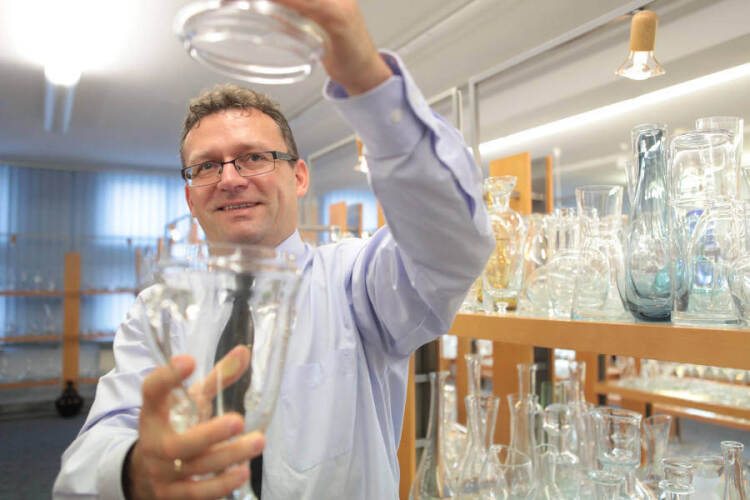
Wojciech Kasza, Director of Logistics and Planning, Krosno Glassworks “KROSNO"
The unambiguous identification of the storage location of products allows for a significant streamlining of warehouse operations, which translates into faster and more accurate deliveries, as well as fewer complaints.
Work inside the warehouse
Permanent and daily work in the warehouse includes:
- replenishment of fixed storage locations for material (assignment of fixed storage locations for material that is often issued from the warehouse in smaller quantities than a whole pallet). Appropriate settings in the material master data as well as the assignment of specific strategies enable automatic generation of transfer orders for replenishment operations and for material releases;
- commingling of material in storage areas (work generated by the warehouse administrator to better manage storage areas).
Of course, the above work (transfer orders) go into dedicated queues in the warehouse for better visualization of workload, and thus more efficient management of employees and equipment.
Completion and release of materials
In order to manage the work during picking more efficiently, the system itself appropriately divides the transfer orders for picking materials from the corresponding types of warehouse into full-pallet picks with homogeneous material and mix picks (the possibility of picking an order for goods in parallel by several employees), which are then assigned to dedicated pick queues.
Warehouse operators assigned to individual queues retrieve orders and then collect the material, taking into account the implemented paths in the warehouse (optimization of the path to be traveled by the operator takes place). After retrieving a full homogeneous pallet or completing a mix pallet, the pallet is set aside in a dedicated place, e.g. a dock number or a staging area, from which physical loading onto a means of transport will take place.
Pallets as handling units
Retail chains, which mainly operate a warehouse in Podgrodz, have specific requirements for pallet labeling. They demand that each pallet (e.g., sent to a specific store) be labeled with information about what is inside and in what quantity. For this reason, and in view of the planned implementation of the solution in the other “KROSNA" warehouses, full and mix pallets are treated as handling units and labeled with SSCC (Serial Shipping Container Code, Serial Shipping Unit Number) numbers. This is an 18-character code, the uniqueness of which is guaranteed for at least one year after posting by the global GS1 organization, to which Poland also belongs.
This most widely used handling unit identifier allows individual tracking and easy identification of a pallet worldwide.
The customized solution used in SAP WM allows automatic packing of handling units for deliveries for all pallets shipped to customers. An additional advantage is the ability to add additional materials to already packed handling units (additional customer sales order after already packed deliveries – allowing customers to add goods until the materials are loaded on the means of transport).
Picking, packing, re-packing and printing of handling units is done using only one custom terminal transaction, which significantly speeds up the work of warehouse workers and allows full control over materials shipped to customers.
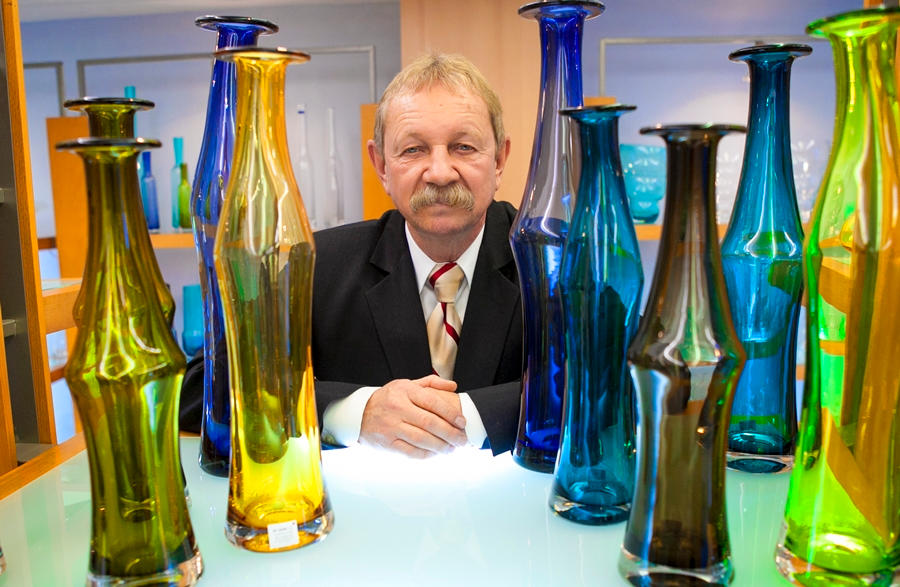
Michał Michalski, Head of IT Business Support Department, Krosno Glassworks “KROSNO".
Motivation of the team and support of the management
At present, SAP is operating at Krosno Glassworks in the following areas: PP, MM, SD, CO, FI, FI-AA. The warehouse management module is already working in the Podgrodzie warehouse and the KHS Export Finished Goods Warehouse. Finished Goods Warehouses Mechanical Production, Finished Goods Warehouses Manual Production Country (projects in progress) and Technical Warehouses are waiting to be launched SAP WM. Next year we will implement the WM module in production. We are also moving towards launching the LE-TRA transportation module.
The benefits of implementing SAP are the fruit of long, usually hard and difficult work. The peculiarity of the difficulty stems from the fact that we are not talking about the success of an individual or even individuals, but success resulting from great cooperation. This cooperation involves a multitude of people involved in the project, but also a multitude of people not directly involved in the process, for whom SAP will become a working tool – the company’s employees.
When implementing a system, basic conditions must be met in order to achieve the desired goal. One of the most important is the proper selection and preparation of the team – an incredibly important factor – these people are supposed to learn a new system of work after having often worked for years according to a different scheme. Hence, it is very important that the goals are strictly and clearly defined – they must be unified, universally known, to guide everyone. Such – working with enthusiasm – working team was set up to implement MW in Krosno.
Another important aspect is the support of the management. For a project to succeed, it is necessary to have the full support of the board of directors for the project and the implementation team. I know from experience that there are sometimes problems with this. Often there is a lack of adequate interest on the part of the board, and when the supervisor doubts the success, the team loses motivation and a sense of purpose in their actions.
For the launch of the WM module, we received full support from General Director Dariusz Gawronski and Deputy General Director Piotr Kandefer.
It is certain that an implemented and smoothly functioning system brings many benefits and can be trusted. However, it is important to remember and sensitize its users at every step that they are responsible for it. We are fallible, and it is the system that is the tool in our hands.
A system startup is a success, but a half success. Leaving it at the startup stage makes the company the keeper of the data recorder, while the main goal, after all, is to achieve economic, technical, organizational results. Extracting relevant data for analysis supports strategic or profitability decision-making. This is possible by permanently analyzing the profitability of logistics processes with SAP. So I encourage you to explore the system and wish you good luck with SAP!
Michał Michalski, Head of IT Business Support Department, Krosno Glassworks “KROSNO", manager of the described project
Inventory balancing between warehouse management (WM) and materials management (MM)
When performing work in the warehouse, sometimes the goods will be mistakenly put away in the storage area, other times there will be an assortment swap in the storage area, etc.
A non-standard mechanism was used to “clean up" the differences resulting from daily warehouse work and to distinguish them from the differences revealed after the inventory process (in the SAP standard such differences are treated equally). Namely, the system itself in the background recognizes whether a plus or minus difference arose in daily warehouse work or was shown for the inventory process.
The resulting differences are appropriately posted to separate accounts, which greatly improves the transparency of account entries and is an additional motivator for continuous improvement in the quality of work performed in the warehouse.
Stocking up in one day
The warehouse in Podgrodzie is a new warehouse that was launched in parallel with the launch of the SAP WM system. The first major operation that had to be carried out, and a kind of test of operational efficiency, was the stocking of the warehouse before the launch.
First, the goods were physically arranged on warehouse racks, and then proceeded to stock them in SAP WM. A customized approach was used for this task as well.
Rack-by-rack and place-by-place operators scanned EAN codes of materials and entered the quantity of goods on pallets. In parallel, in the background, a reposting operation took place from the SAP MM inventory to the WM inventory, and then a WM transfer order was generated and confirmed. The confirmation of the transfer order was followed by the printing of a label in the SSCC standard, with additional information about the location of the material in the warehouse.
Facilitating the process so much enabled the entire warehouse to be stocked in just one day. Then, on the same day, routine warehouse operations began.
Rationalization of inventory management
Automation of warehouse operations in SAP WM translates into improved customer service. Thanks to the system, at any time it is possible to find out with great accuracy exactly where the goods are in the warehouse and what their status is (in the process of receipt, picking, in the process of release).
As Wojciech Kasza, Director of Logistics and Planning at Krosno Glassworks “KROSNO" points out: “The unambiguous identification of the storage location of products together with the correct storage unit, which will include, for example, the quantity of material, allows for a significant improvement and reduction in the duration of warehouse operations, which translates into faster and more accurate delivery, as well as fewer complaints."
The achieved rationalization and increased efficiency of inventory management, process fluidity and rapid adaptation to customer order fulfillment requirements are the primary benefits of implementing SAP WM functionality.
“A major success of the implementation team is the fact that the new system was launched without any interruption in the operation of the warehouse. Proper organization and regime in the schedule of preparation for the launch, professional approach to the task and exemplary cooperation with the consultant are the basics, thanks to which our customers did not feel the usually difficult stage of implementation. After that, they can only be more satisfied with the service. The solutions tested in the Podgrodzie warehouse as well as the new ideas having their foundation in the implementation in question will be implemented in the WM module implementations in the next warehouses of KHS “KROSNO" SA, whose production start is scheduled for the next months of 2013 and 2014″. – Wojciech Kasza adds.