


Companies using SAP are increasingly looking to save money and simplify business processes. In areas where there is a need for increased document exchange with a large and diverse group of counterparties, there is an intensive search for opportunities to eliminate costly and time-consuming operations associated with printing and sending out paper documents by traditional means.
While the exchange of printed documents with permanent IT-sophisticated partners can be successfully replaced by an electronic document interchange (EDI) subsystem, the implementation of a distributed system in cooperation with a large number of partners with varying degrees of systems sophistication should be based on simpler, low-cost and widely available solutions.
What is All for One EasySign?
All for One EasySign is a tool designed for companies using the SAP ERP system to sell products, goods and services to a large number of customers with varying degrees of computerization. It allows you to send VAT invoices to customers in electronic form, as required by Polish law.
With EasySign, invoices generated in the SAP system are sent to the customer in the form of PDF files, accompanied by a qualified or non-qualified electronic signature. Thus, it can be said that EasySign is a toolkit that facilitates the mass signing of invoices as much as possible and automates the process of archiving and sending signed documents to customers.
At Tuplex, the EasySign product was implemented in an SD module that had been in operation for some time, using the SAP http ContentServer archive. Aside from minor configuration work and a few programming changes, this allowed the existing business processes to be used without major changes.
All for One EasySign is a comprehensive solution that provides:
- file archive connection,
- signature mechanism,
- EasySign console,
- The ability to interfere with the content of emails sent.
Archive of invoices only in electronic form
One of the main goals, which was formulated at the implementation concept stage, was that Tuplex would completely abandon the storage of paper invoices, regardless of the consent of the partner (the invoice recipient) to send the document electronically.
This necessitated the recognition of two situations. The first, in which we can send an invoice in electronic form, that is, as stored on Tuplex’s side, and the second, in which the document to be sent must be printed and then sent by the traditional method. However, in both cases, Tuplex on its side archives the document only in electronic form, that is, in neither case are copies of the invoice printed.
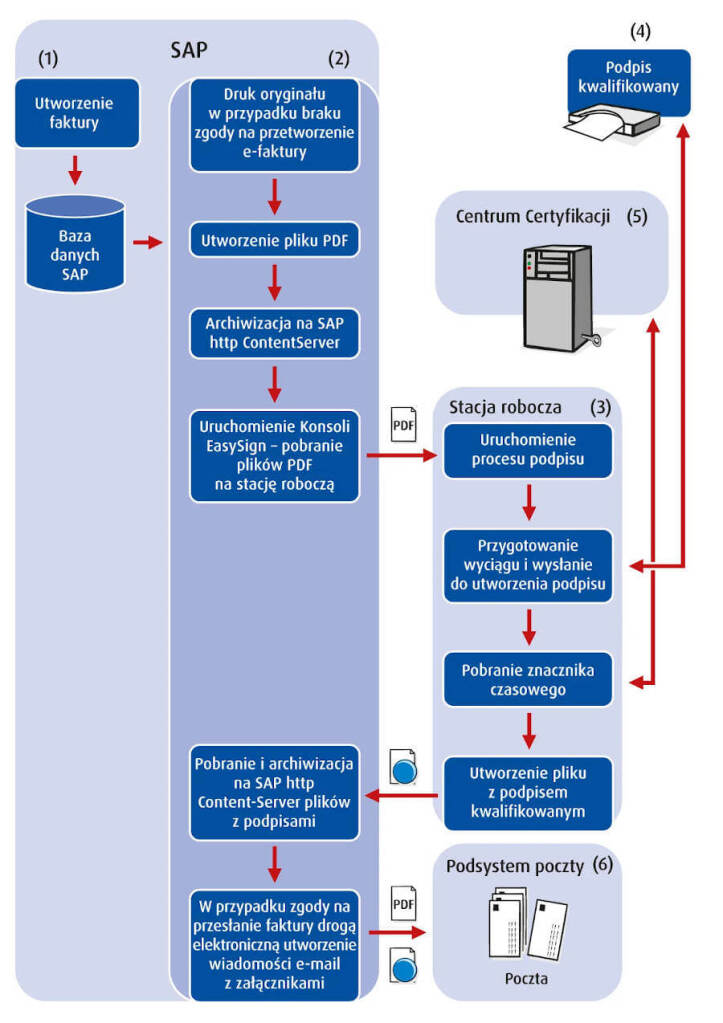
Thus, the process begins with an automatic check of the so-called “e-invoice sending condition". Such a condition is a contact person with the “Consent e-invoice" function and an existing e-mail address found in the invoice payer information in SAP. If this condition is not met, the output information is attached once outputting the document to the printer – this printout will be sent to the invoice payee by the traditional method. Then, regardless of the check, the document is archived as a PDF document on SAP http ContentServer. To generate invoices in PDF form, the standard Smartforms form functioning for standard invoice printing is used. It should be noted that the form printing program in Tuplex is very complex, and one form supports all types of invoices and correction invoices in both Polish and English.
Duplicate invoices are also derived in the same way, a new pdf file is created and either printed or will be sent electronically.
All for One EasySign console
The All for One EasySign console is the heart of the entire tool. It allows you to select documents by various parameters, such as invoice number, date of removal, department or sales office. What’s more, it allows you to filter documents by their processing status – including invoices moved out, signed, archived, etc.
In the option with a qualified signature, submitted by a specific person via a smart card and a dedicated device, the standard procedure involves running the console for a set period of time – most often one day. As a result, a list of invoices derived during this interval is generated. Then all derived and unsigned invoices are copied to a workstation, which is a dedicated Windows-protected personal computer (this computer has access to the SAP system via the RFC protocol).
Invoices on the workstation are signed by the user in bulk, with the help of a qualified signature using third-party dedicated software. Such a signature, as a kind of digital certification of the identity of the person using it, must be confirmed by a body that has the authority to do so. The role of a trusted, so-called “third" party is played by certification centers. These offices perform certificate issuance and management services, as well as services related to the issuance of timestamps. The signature is in a separate file and together with the actual document forms a kind of confirmed and secured whole.
In the option with a non-qualified certificate-based signature, the signing process can be automated. An appropriate cyclically run process downloads files from the archive and adds an electronic signature to them. Invoices prepared in this way are ready to be automatically sent to recipients.
Using the All for One EasySign console, the user downloads the signatures corresponding to the documents. These are then archived automatically on the SAP http ContentServer (or other document archive). If the recipient of a given document meets the “condition for sending an invoice electronically," an e-mail with the attached document and matching signature is automatically created and such an e-mail is sent to the recipient. The content of such an e-mail, as well as its title, depends on the data contained in the document. As an example, the title changes between Invoice <invoice_number> and Duplicate <invoice_number> when sending the original and duplicate of a given document.
The All for One EasySign console also allows easy access to documents archived on SAP http ContentServer.

Krzysztof Dudzinski, Director of Logistics and IT, Tuplex Ltd.
Simple tool, big benefits
We decided to implement EasySign primarily because we wanted to do away with archiving paper invoices and offer customers a new service – that is, transmitting invoices electronically. This is a non-trivial problem – we issue about 100,000 invoices per year.
The obligation to store invoices for 5 years, with this scale of sales, meant that the amount of stored paper grew every month, taking up more shelves in the archive. On top of that, there was a huge amount of printed paper and the time of people who had to properly collect and catalog all the documents.
That’s why Tuplex decided to only use an electronic archive, regardless of whether or not we received permission from the customer to send e-invoices. This has solved the problem of paperwork and extra work, and brings tangible savings in printing costs by completely eliminating the need to print copies of invoices.
Another benefit, of course, is the ability to send invoices in bulk by email, to those buyers who have agreed to it. We save on postage costs, we get rid of printing, enveloping, franking, record keeping – in other words, we save on the time of people in the sales department. Admittedly, we still send a large part of invoices traditionally, but with a reduced scale it is easier organizationally and cheaper.
What is important for us, when sending electronic invoices we act in accordance with the requirements of Polish law. The status of a qualified signature is equivalent to that of a handwritten signature. The signature is linked to the data to which it is attached, in such a way that any subsequent change to this data is recognizable. I would also add that EasySing provides the ability to view archived documents, for example, by the tax inspection office or by employees to see the appearance of the printed invoice. Also, due to legal requirements, we decided to send all corrective invoices via snail mail because of the need to confirm receipt by the customer.
When looking for the right solution, we took into account the fact that our recipients do not always have advanced IT tools with which they can receive and read documents. BCC’s solution (currently All for One Poland) proved to be optimal in this regard. Tuplex, as an entity issuing invoices, must have the EasySign tool and a signature application, but already the entity receiving the document by e-mail is not required to install any complex software. An Adobe Acrobat Reader viewer is all that is needed to view the document, and the signature can be verified using free software provided by the certification center.
EasySign has thus proven to be a simple and relatively inexpensive way for us to simplify and reduce the cost of a time-consuming process. We have certainly become greener with this application, and the process of signing electronic invoices itself is really easy and fast.
Krzysztof Dudzinski, Director of Logistics and IT, Tuplex Ltd.
Implementation time
Since the EasySign product was implemented at Tuplex on an existing SAP ERP system and a fully functional sales module, the implementation time was relatively short. All for One EasySign also integrates easily with already implemented SAP functionalities. The entire implementation began with two meetings held in December 2011, at which the procedure for Tuplex’s transition to an electronic version of invoicing was determined, and the necessary modifications were defined both in the EasySign console and in the SAP ERP system itself, so that the whole thing would fit in as well as possible with the nature and way Tuplex conducts sales. Work on the system began in January 2012 and culminated in the transfer of the solution to the production system at the beginning of March 2012. After the production launch and confrontation with daily operations, the EasySign console was further modified slightly to meet the requirements imposed on it even more efficiently and to support users in fulfilling their tasks effectively and efficiently.