

Onet started using the platform SAP ERP platform at the beginning of 2011. Today, it uses tools to support sales and distribution (SD), financial accounting (FI), materials management including procurement (MM), controlling (CO) and the Process Integration (PI) platform. In December, the group’s SAP solutions added another platform, the SAP BI data warehouse.
After more than a year and a half of preparatory work and a year since the production launch of all systems, we can repeat after Alexander the Great: “There are no impossible things, there are only difficult things to do."
The biggest challenge during the SAP implementation was its integration with key domain systems in less than two months after the analytical work was completed. The final modular and technical concepts for the project and its integration were approved in September, and implementation began in early October.
The project team, consisting of eight to ten integration implementers, depending on the needs of the established WBS (work breakdown structure), had quite a challenge. For the implementation of all the changes to the four key domain systems within the planned timeframe meant working more than 3,300 man-hours in less than 40 days.
Onet’s domain systems
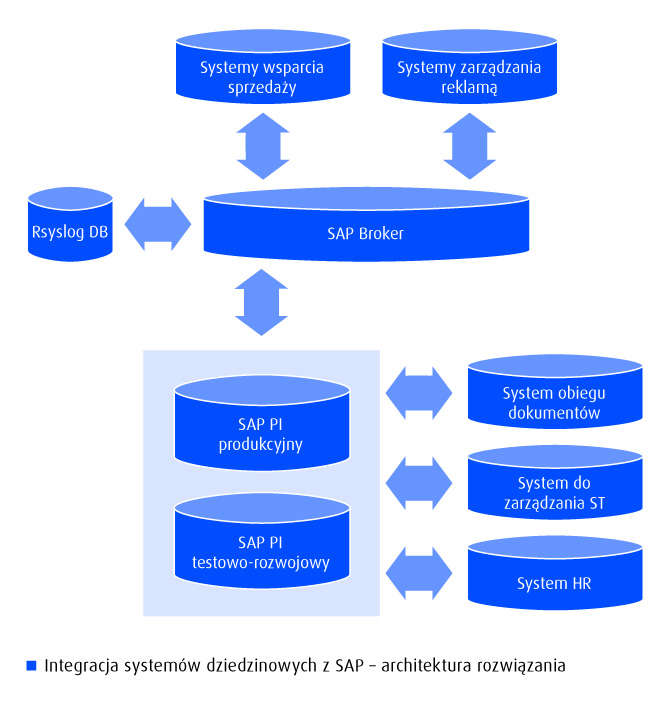
We integrated the most important systems with the SAP platform: the B2B/B2C sales support, advertising management support, electronic document workflow and fixed asset management system. A number of dedicated, thematic interfaces were created to support them.
“When implementing the SAP ERP platform at Onecie, we wanted first and foremost to bring about a consistent and efficient transactional and reporting platform that would enable us to better control the company’s resources and make fuller use of data from other systems," – says Jerzy Gulczynski, IT Production Director at Onecie.
What did the integration consist of?
The process of implementing SAP as a standalone ERP platform and the process of integrating it with in-house systems had to be coherent, without causing interruptions to systems already in operation and maintaining data integrity.
“After implementing SAP ERP, we are able to obtain on-demand information on processes and resources regardless of where it originates in the organization. As a result, we have been able to increase the scope and quality of information for decision-making at all levels of management," adds Jerzy Gulczynski.
The implementation process was successful thanks to the meticulous implementation of plans to modernize the IT infrastructure, the use of the latest technologies on the Onet side and on the SAP PI side, which made it possible to build dedicated interfaces, meeting the remaining requirements in terms of diversity of communication formats and protocols.
Adam Kopycinski, Project Manager, Onet Group
What design approach?
“We used an evolutionary design approach, dividing the entire process into two-week cycles. The first phase included only the technical background, which allowed us to effectively test the solutions used to integrate with the SAP PI platform." – Adam Kopycinski comments.
This approach also enabled frequent testing to check that new changes did not negatively affect already existing system processes, and to give ongoing information on the status of the work.
In the second phase of the project, the work product, which was all sales transaction systems integrated with SAP, was made available to business teams. Their task was to conduct functional tests, mainly to identify inconsistencies in data, processes for recalculating amounts in documents or the correctness of accounting.
“In the end, we conducted three series of integration and functional tests, thanks to which we were able to eliminate several problematic business processes in domain systems right from the start," – Adam Kopycinski says.
Testing in a vast IT solution was a critical element in the entire project, not only because of the implementation deadline, but also because of the fact that real-time online “cash flow" was taking place. In such a case, you can’t afford errors and data losses in the systems, serving thousands of Internet users who were at the time completing, for example, transactions for the purchase of a domain or an advertising campaign.
“The high project awareness in our organization and extensive experience in project management allowed us to adapt comfortably to the short lead time and the methodology adopted by BCC (currently All for One Poland) for SAP implementation in organizations." – Adam Kopycinski concludes.
Development
The development activities mainly consisted of building solution prototypes for those parts of the systems needed to run SAP that were responsible for supporting sales processes and advertising management.
Work was also carried out in parallel for systems providing electronic workflow and fixed asset management. Implementation was carried out using the TDD (Test Driven Development) technique, consisting of three main steps:
- Creating a unit test,
- Implementation of the right functionality,
- code refactoring.
Such a way of conducting the project and the constant participation in the project team of people seconded from the business departments made it possible to make the necessary changes in the processes in a controlled and safe way for related processes and to maintain backward compatibility (regression).
The tests created at the implementation stage are now used in the “continuous integration" (Continuous Integration) process, providing constant monitoring of the correctness of the system’s operation and being a factor in reducing the risk of problems during its further development.
Piotr Rydzewski, Information Systems Designer, Onet Group
Solution architecture
During the course of the project, we set ourselves the task of creating a mechanism to integrate with SAP internal systems communicating with different protocols, with different management and control mechanisms.
“These are systems that are not consistent because of the nature of the work or, for that matter, because of the technology in which they were made. The multiplicity of programming languages used: perl, python, flex, .net, or databases used: oracle, mysql, mssql, in many cases did not allow to unify the transport layer with a minimal contribution to the modernization of the system." – says Piotr Rydzewski.
It was necessary to enable efficient connection of domain systems with SAP at a level that could exceed tens of thousands of messages per month. As a result, it was decided to base communication mainly on synchronous messages using the SOAP protocol. Due to the tasks set, the following messages, among others, were created:
- customer definition,
- contract definition,
- contract definition,
- advance settlement,
- Invoicing (from SAP to domain systems).
In order to ensure transparency and uniformity of communication, the SAP Broker module was created to convert the internal protocols specific to each domain system into a single consistent language that could be used to communicate with SAP.
“The task of this mechanism was to ensure the consistency of data and control of operations performed, so that domain systems thus gained the ability to communicate with one system common to them using natively used protocols," explains Piotr Rydzewski.
This solution minimized the amount of work on both the SAP side and the domain systems themselves, and simplified the architecture of the entire solution.
Monitoring of the overall system was also an important aspect of the project. The mechanisms involved in communication with SAP were connected to a central 24-hour monitoring system. It triggers an alarm after reporting any irregularities related to both network problems and internal problems of individual modules.
Resolution of the resulting system malfunctions is supported by the Information Technology Infrastructure Library (ITIL) compliant process used in the company. The integrated process for handling failures is designed to restore services to proper operation as quickly as possible and to ensure that their unavailability has the least negative impact on the organization’s operations.
Independently, the mechanisms involved in communication with SAP in order to enable post factum analysis of possible irregularities have been expanded to include the possibility of logging in a central database the course of all communication.
“In practice, it is possible to reconstruct the communication path for any request directed to or from SAP." – Piotr Rydzewski points out.
In order to capture and store information on the stages of processing or receiving documents transmitted or received from SAP, rsyslog was used, which allows convenient configuration of the actions to be performed on the processed messages.
In our case, the collected information is transferred to a central database. Thanks to the independent recording process, there are no delays in the communication process with SAP, and the capabilities it provides to protect against the loss of processed information in case of network problems, allowed us to have a high degree of confidence that the various stages of information transport will be recorded in a way that is not intrusive to the overall process.
Basis
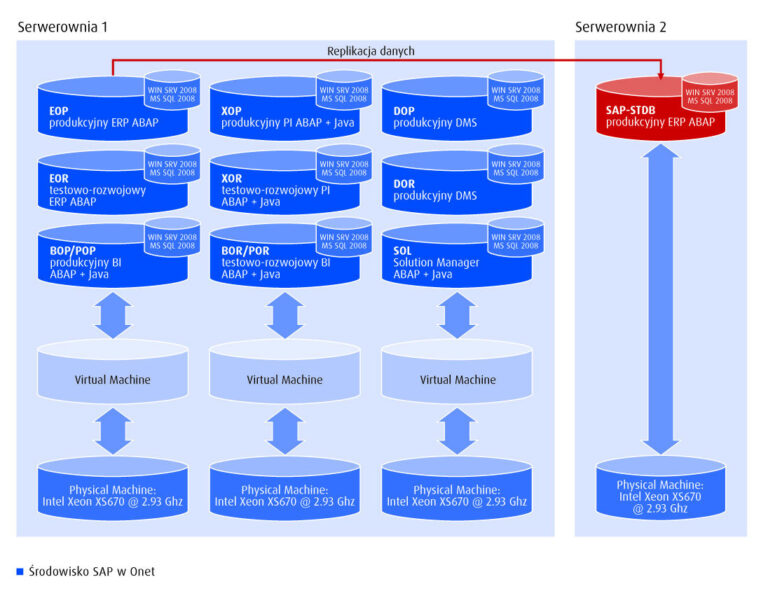
The SAP platform was implemented using a virtual environment. The entire solution is based on the use of virtual machines installed on several physical servers with parameters: CPU 2 x Intel Xeon 4C X5570, RAM: 72 GB.
In order to ensure the continuity of work and the possibility of smooth operation of the system, the following solutions were used:
- Virtual Machine environment – this gives us the ability to switch individual machines without affecting SAP users. Virtual servers can be moved “hot" without any loss of data or network connection. By using virtualization, we reduce the risk of hardware errors and have the ability to migrate virtual machines within a cluster consisting of physical servers.
- Data center redundancy – an architecture has been prepared in the backup data center (a copy of the main server) to enable a smooth switchover of the SAP platform in case of loss of the main data center.
- Disaster Recovery Planning – we conducted DRP tests, giving us a guarantee to restore the entire SAP environment from backup on a completely “clean" hardware or virtual environment in a few hours. Switching the SAP solution between server rooms was also part of the test procedure.
- Monitoring: On-line – all physical as well as virtual servers are connected to the central monitoring system – a proprietary solution of our organization that allows us to control and analyze the parameters of hardware and delivered services; and collective – once a day we perform an analysis of the correctness of the SAP platform operation.
Central information system
The SAP platform has become the organization’s central information system. Integrated with domain systems, it provides a synchronized database of key information, while also ensuring its consistency. From a technical point of view, the administration and functional development of the entire solution of both SAP and the peripheral systems are systematically improved and processed in accordance with established methodologies.
“Implementing such a complex system on a living, vast organization was quite a challenge for us. The solution implemented at Onet has significantly influenced the consistency of the management information obtained, while speeding up many of the company’s internal processes. Today, it is difficult to imagine the functioning of a large media company, as Onet has become over the last 15 years, without the use of state-of-the-art ERP solutions". – Adam Kopycinski concludes.
SAP PI at BCC – Implementations and Outsourcing
The greater the number of systems used in a company and the more complex the network of relationships between them, the more important the role of central administration and management of the entire IT landscape.
Part of the SAP NetWeaver family, the SAP Process Integration (SAP PI) solution is a versatile and powerful platform that facilitates the efficient implementation and maintenance of changes to the IT infrastructure, as well as the integration of IT systems, regardless of whether SAP or any other systems form the basis of the company’s workflow.
SAP PI mediates both the exchange of master data – information about business partners, materials, products and employees – and transactional data – orders, deliveries, invoices, payments. It allows you to organize the company’s systems landscape, eliminate redundant workloads and automate many activities and processes. The exchange of EDI messages with trading partners using SAP PI brings tangible benefits in ongoing business operations.
BCC (currently All for One Poland) is a leading provider of SAP integration solutions. Our experience includes dozens of integration projects – both related to integration of SAP ERP with other SAP systems in the company – e.g. SAP CRM, integration of SAP with SAP systems of customers’ partners, and integration of SAP with other in-company applications and non-SAP systems of suppliers and customers of our customers (EDI).
In addition to the work done for Onet.pl, other examples of BCC’s integration projects include the migration of dozens of telecommunications interfaces to the SAP PI platform, integration of SAP CRM with external systems, implementations in the automotive industry using the VDA standard, integration of ERP systems with WMS and POS systems, EDI interfaces for manufacturers in the FMCG industry, and many others.
BCC’s offer in this area is comprehensive – in addition to implementations, we also provide outsourcing services – including hosting and administration of the SAP PI environment.
Tomasz Wojciechowski, head of the BCC Competence Center for SAP PI